
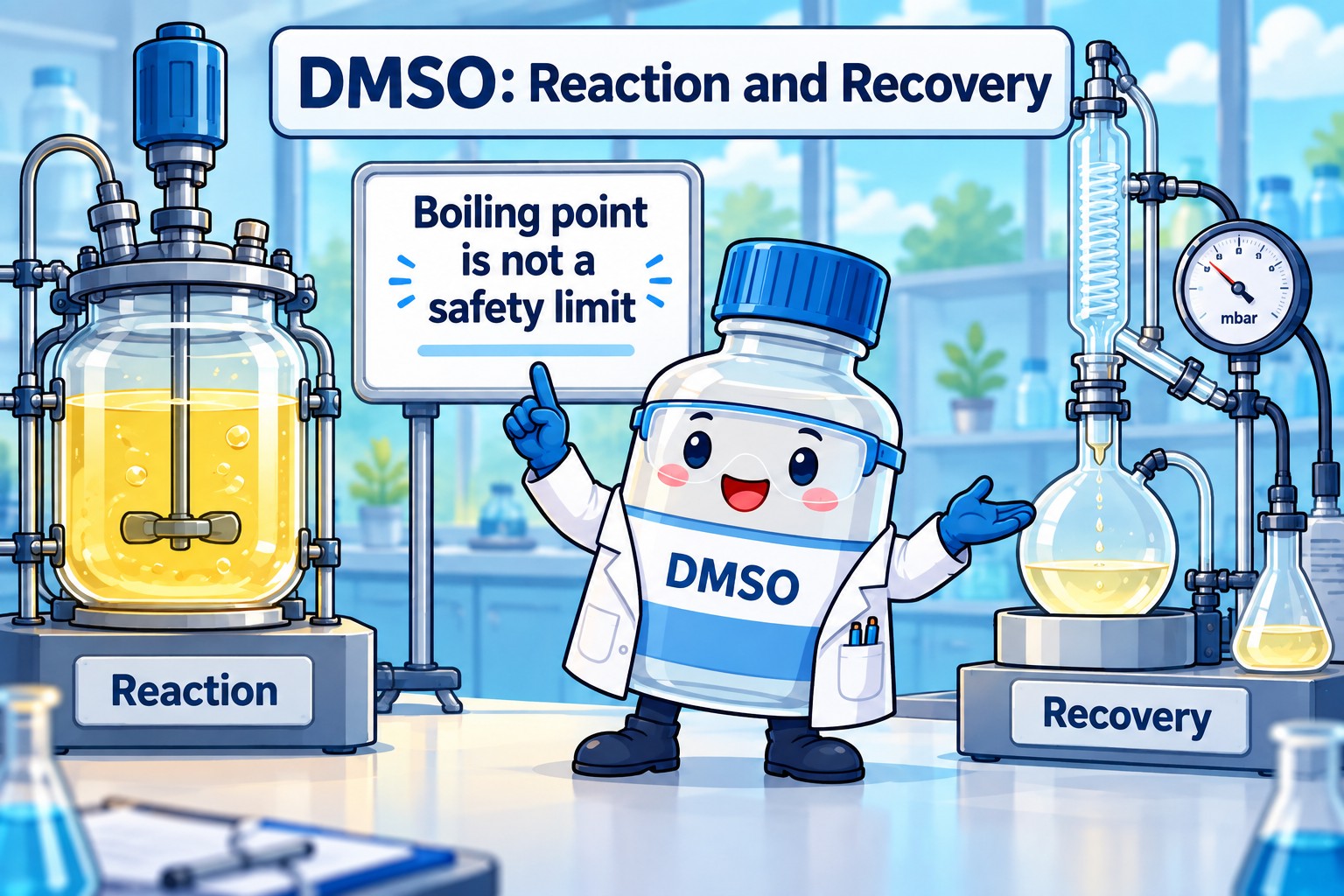
DMSO has a normal boiling point of roughly 189–190°C, and that single property shapes both how it is used as a high-temperature reaction solvent and how it is later removed and recovered. It allows reactions to be run hot at ambient pressure, but it also makes DMSO harder to strip than lower-boiling solvents and encourages recovery rather than single-pass disposal.
- DMSO boils near 189–190°C at atmospheric pressure and is fully miscible with water.
- Removal and recovery usually rely on reduced-pressure separation, with conditions set by the actual mixture.
- The boiling point is not a safe operating-temperature limit; reactive mixtures need separate hazard evaluation.
Boiling point and why it matters
A high boiling point means DMSO can serve as a high-temperature reaction medium without evaporating at ambient pressure, which is useful for reactions that need heat. The same property works against easy removal: distilling DMSO near 190°C can be impractical when products are heat-sensitive or energy costs matter. The NIST phase-change data provide the reference boiling point and related thermal properties.
| Property | Value / description | Practical implication |
|---|---|---|
| Normal boiling point | ~189–190°C | High-temperature medium; harder to strip |
| Water miscibility | Fully miscible | Drying needed; aqueous streams complicate distillation |
| Polarity | Highly polar, aprotic | Dissolves a wide range of organics and salts |
Removing DMSO under reduced pressure
The standard way to separate DMSO at lower temperature is reduced-pressure distillation: lowering the pressure lowers the effective boiling point so the solvent can be removed without approaching 190°C. A published recovery example describes reduced-pressure separation as part of a DMSO recovery scheme.
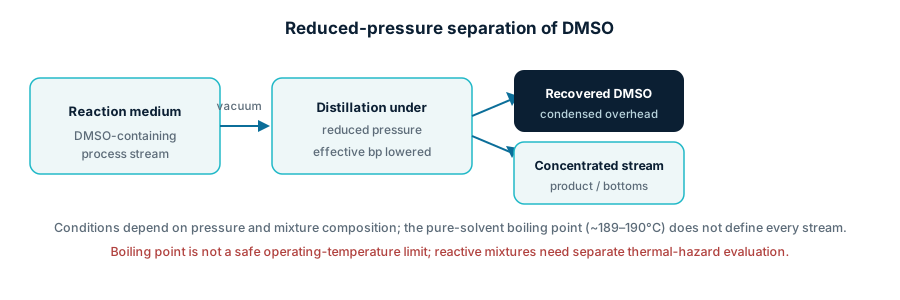
The actual conditions depend on pressure and on the mixture—including water and dissolved material—so the pure-solvent boiling point does not predict the behavior of every process stream. Azeotrope-like behavior and dissolved solids can shift the temperature and the separation quality significantly.
Vapor pressure and vacuum levels
Boiling occurs when a liquid’s vapor pressure equals the pressure above it, so lowering the operating pressure directly lowers the temperature at which DMSO can be distilled. In practice this means a rotary evaporator, a wiped-film evaporator or a vacuum distillation column can remove DMSO at temperatures well below the atmospheric boiling point, with the achievable temperature set by the vacuum the equipment can hold. Deeper vacuum gives lower distillation temperature but can require tighter equipment and condensers capable of capturing DMSO vapor at the lower pressure. Because DMSO and water are fully miscible, a water-containing stream does not separate into a clean solvent layer and instead distils according to the composition and the vapor-pressure behavior of the mixture, often requiring a dedicated dehydration step.
Designing a recovery loop
A workable recovery loop combines concentration, dehydration and purification matched to the feed. The DMSO-containing stream is first concentrated under vacuum, water is then removed—typically within the distillation sequence or a separate dehydration stage—and the recovered solvent is further treated to remove polymer-related residues, salts or metals before reuse. Condensers and receivers must handle DMSO’s high boiling point and its tendency to freeze near room temperature (DMSO freezes at about 18°C), so traced or insulated lines are sometimes needed to prevent blockage. The recovered material is then tested against the specification of the receiving process; solvent that is acceptable for a less sensitive step may not meet the metal and particle limits required for electronics.
Why recovery is often economic
Because DMSO is used in substantial volumes and is relatively expensive, recovering it from reaction or spinning streams is frequently more economic than treating it as waste. Recovery routes typically combine separation with dehydration and purification, and the recovered solvent is qualified for the receiving process. The carbon-fiber precursor recovery article describes one such route in detail.
Boiling point is not a safety limit
The boiling point describes a phase change of the pure solvent; it does not establish a safe temperature for a reactive mixture. Certain strong bases react exothermically with DMSO and can form unstable species well below the boiling point. Published work on sodium hydride with DMSO documents why solvent boiling data alone cannot establish reaction safety (thermal-hazard study).
Strong bases, hydrides and other reactive systems in DMSO require calorimetric and thermal-hazard evaluation, with appropriate temperature control and relief. The 189–190°C boiling point is not an operating limit.
Practical guidance
Plan removal and recovery when the route is designed, not after scale-up: define the pressure and temperature the equipment can achieve, account for water in the stream, and set a specification for recovered DMSO that matches its intended reuse. Recovered solvent qualified for one application, such as PAN spinning, is not automatically qualified for a tighter application such as electronics. Where reactive chemistry is involved, the thermal evaluation should precede any decision to run at elevated temperature, and its conclusions—not the boiling point—should set the operating and relief basis and be documented in the process safety file.
Energy and waste accounting belongs in the comparison as well: vacuum distillation and condensation carry operating costs, but they reduce both fresh-solvent purchase and waste treatment, and in high-volume streams such as PAN spinning the savings compound over many batches. Recording recovery yield and the quality of each recovered batch also provides the data needed to decide whether the loop is meeting its target or needs further purification. A simple log of distillation pressure, residual water and recovered quality for each campaign makes drift visible early and supports steady refinement of the operating envelope.
Discuss DMSO grade and recovery
Share your process stream and reuse target. We will help match the fresh or recovered specification.
Frequently asked questions
At what temperature does DMSO boil?
About 189–190°C at normal atmospheric pressure; under vacuum the effective boiling temperature is lower.
How is DMSO removed from a reaction?
Most commonly by reduced-pressure distillation, which lowers the boiling temperature and protects heat-sensitive products.
Can recovered DMSO be reused?
Yes, after dehydration and purification, but it must meet the specification of the receiving process; reuse qualification is application-specific.
Is the boiling point a safe maximum reaction temperature?
No. Reactive mixtures such as strong bases in DMSO can develop hazards well below the boiling point and require separate thermal evaluation.
Why does water complicate DMSO recovery?
DMSO and water are fully miscible, so they do not separate into layers; the mixture distils by composition and usually needs a dedicated dehydration stage.