
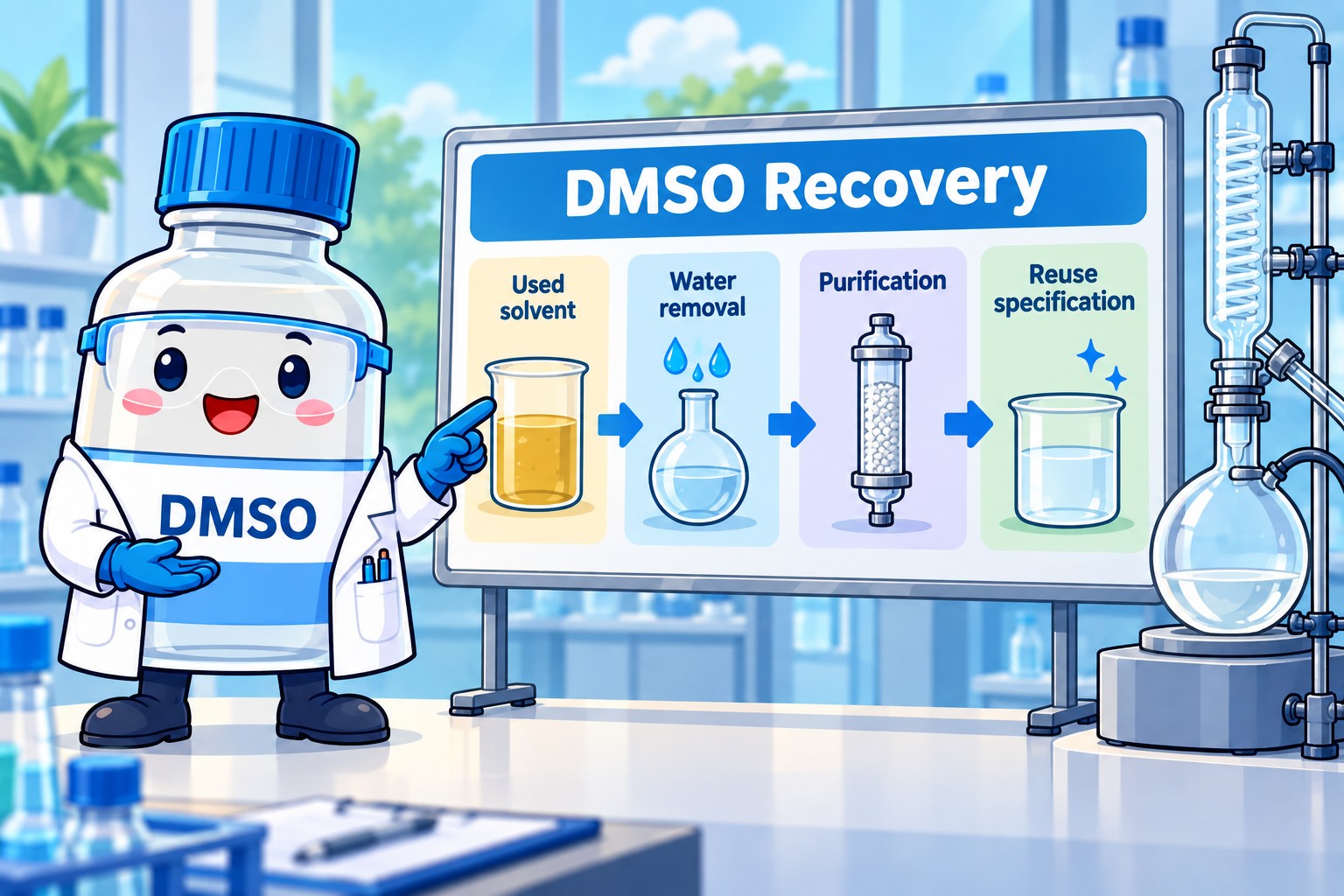
DMSO can be recovered from the solvent streams of carbon-fiber precursor production and purified for reuse. In high-volume wet spinning, large amounts of DMSO leave with the coagulation and wash streams, so a reliable recovery route is both an environmental control and a major cost factor. A published recovery process describes how such feed is treated and returned to a usable condition.
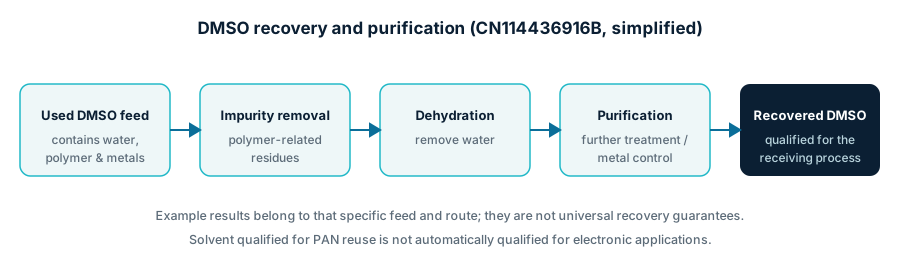
- The published route combines impurity removal, dehydration and purification of the DMSO feed.
- It addresses water, polymer-related residues and metal contamination.
- Recovered DMSO is qualified for the receiving process; PAN reuse does not imply electronic-grade suitability.
The recovered solvent stream
The feed to recovery is not clean DMSO. It contains water from coagulation, polymer-related residues and oligomers carried over from spinning, salts and trace metals, and its composition varies with production. Recovery has to take this mixed, contaminated feed and return DMSO of a quality that the precursor process will accept without degrading the dope.
Steps of the published recovery
Patent CN114436916B describes a route that includes impurity removal, dehydration and further purification of DMSO-containing feed. Impurity removal targets polymer-related material that would foul equipment or return to the dope; dehydration removes the water picked up in coagulation; and further purification brings the solvent to the required quality, including control of metal contamination. These stages may combine filtration, treatment and distillation under reduced pressure, reflecting DMSO’s high boiling point and its full miscibility with water.
Contaminants that must be controlled
Three contaminant classes dominate. Water changes dope viscosity and coagulation behavior, so it must be reduced to a level the spinning process tolerates. Polymer-related residues and oligomers can cause gels, filtration problems and filament defects, which is why impurity removal precedes reuse. Metals, whether from process equipment or additives, must be controlled to the level the receiving process requires; this becomes especially important if recovered solvent is ever considered for a more sensitive application.
Qualifying recovered DMSO for reuse
The recovered material is assessed against the specification of the process that will receive it—typically by checking assay, water, residue and relevant metals, and by confirming it produces a clean, spinnable dope. The patent’s example results belong to its specific feed and treatment route; they are not universal guarantees for every plant, feed or equipment set. A solvent qualified for reuse in PAN processing is also not automatically qualified for electronic applications, which impose tighter metal and particle limits.
Integrating recovery with the spinning line
A closed loop collects DMSO from the coagulation bath and wash stages, where it leaves together with water, and returns concentrated, purified solvent to dope preparation, with fresh DMSO added to make up losses. Because water is continuously introduced in coagulation, the dehydration stage has to keep pace with production, and the loop is typically instrumented to track water content and recovery yield so that returned solvent stays within the range the dope requires.
Integration also defines where contaminants are purged. Polymer residues and a controlled fraction of the most contaminated stream are removed rather than endlessly recycled, which prevents salts and oligomers from building up in the loop. Designing these purge and makeup points—together with the quality specification for returned DMSO—is what keeps a recovery loop both high-yielding and compatible with stable spinning over long campaigns.
A high recovery percentage is valuable only if the returned solvent meets the reuse specification. Pushing yield too hard can concentrate contaminants; recovery and purification targets should be set together.
Process and economic considerations
The business case depends on recovery yield, energy for vacuum distillation and dehydration, and the cost of fresh solvent and waste treatment. In high-volume precursor production the recovered volumes are large enough that even small improvements in yield or reductions in residual water compound over time, and consistent recovered quality protects spinning uptime. Monitoring each batch—recording yield and the key quality results—gives the data needed to keep the loop within target.
Pilot data on the actual feed are more reliable than the patent’s example figures when sizing equipment and estimating operating cost, because the feed composition sets the required dehydration and purification load. These data should be gathered before final equipment sizing.
Discuss DMSO recovery specifications
Share your feed composition and reuse target. We can help define the fresh and recovered solvent specification.
Frequently asked questions
What does the published recovery route include?
Impurity removal, dehydration and further purification, addressing water, polymer residues and metals in the DMSO-containing feed.
Are the patent’s example results guaranteed for my plant?
No. They reflect a specific feed and treatment route; recovery performance must be established for the actual stream and equipment.
Can recovered PAN-process DMSO be used in electronics?
Not automatically. Electronics require tighter metal and particle control, so the recovered solvent would need to meet that separate specification.
Why is water a primary target?
Water affects dope viscosity and coagulation, and DMSO is fully miscible with it, so dedicated dehydration is required before reuse.
How are contaminants kept from building up?
The loop purges polymer residues and a fraction of the most contaminated stream while adding fresh DMSO, preventing salts and oligomers from accumulating.