
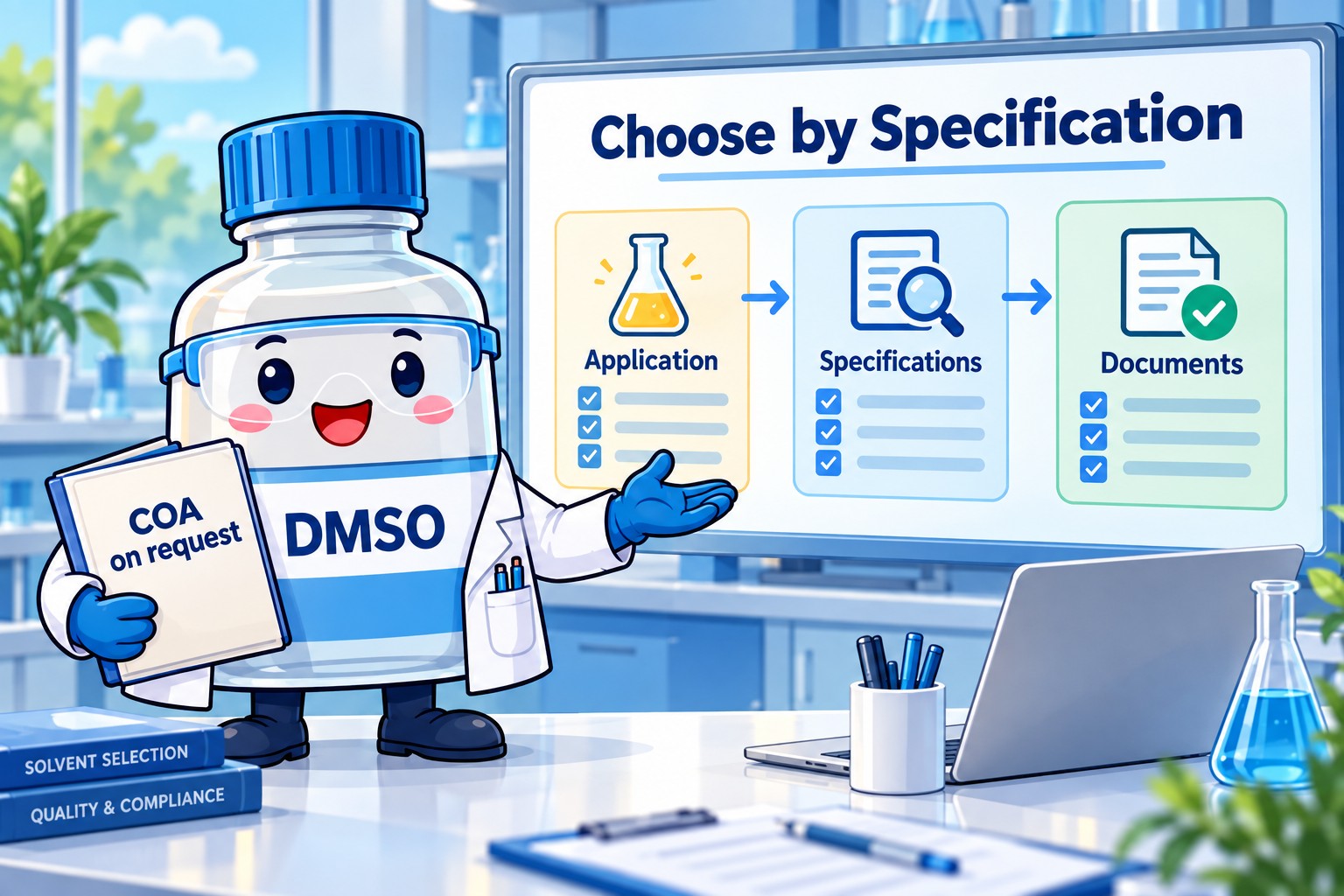
DMSO serves three distinct functions across the applications covered in this Technical Center: a reaction solvent in pharmaceutical and agrochemical synthesis, a chemically participating reagent in an activated oxidation system, and a solvent-based stripper in microelectronics. Recognizing which role DMSO plays in a given step is the fastest way to identify the appropriate grade and specification.
- The same molecule can act as a solvent, an oxidation reagent, or a stripping solvent.
- Each role places different demands on purity, water content and impurity control.
- Specification should be set per application, not from a single overall purity figure.
Reaction solvent in synthesis
In most pharmaceutical and agrochemical steps DMSO is the polar aprotic reaction medium and is recovered largely unchanged. For example, a published clarithromycin route uses DMSO with MTBE in the 6-O-methylation of a protected intermediate, where DMSO hosts the chemistry while methyl tosylate supplies the methyl group (process reference). Here the focus is on a solvent grade with suitable assay, water content and consistent quality.
Reagent in activated oxidation
In a published emamectin benzoate route, DMSO forms part of an activated oxidation system with phenyl dichlorophosphate and actually supplies the oxidation chemistry, converting an alcohol to a carbonyl (process reference). In this role DMSO is a stoichiometric reagent, so assay, water content and the moisture sensitivity of the activated species carry more weight.
Stripping solvent in microelectronics
DMSO is also used for photoresist removal, where heated DMSO dissolves or lifts the resist film (application reference). Suitability depends on the resist and its processing history, and electronic use adds requirements for water, identified metals and particles, with SEMI C53 defining dedicated DMSO Grades 1 and 2.
| Role of DMSO | Representative step | Specification focus |
|---|---|---|
| Reaction solvent | Clarithromycin 6-O-methylation | Assay, water, batch consistency |
| Oxidation reagent | Emamectin activated oxidation | Assay, low water, stoichiometric supply |
| Stripping solvent | Photoresist removal | Water, metals, particles; SEMI C53 |
How to navigate the Technical Center
The articles are organized into four topic groups so you can move from general principles to a specific process. Fundamentals cover the properties that shape every application, including boiling point, recovery and grade selection; synthesis articles walk through pharmaceutical and agrochemical steps, from clarithromycin methylation to activated-DMSO oxidation; electronics articles cover photoresist stripping and the specification of electronic-process DMSO; and carbon-fiber articles cover PAN precursor spinning and the recovery of spinning solvent.
If your question is process-specific—for example whether DMSO suits a particular substitution, stripping step or spinning line—start with the article for that topic and follow its related links. If your question is about which grade or specification to buy, this overview and the fundamentals group are the right place to begin, and our team can help map your application to a grade and a batch COA.
Grade and COA
These uses require application-specific specifications. Purity, water content and relevant impurities should be stated separately, because a single purity figure does not describe the complete product, and an item absent from the batch COA is unreported rather than zero. Use the linked articles in each section to go deeper, and contact us to match a grade to your specific step.
Because DMSO is one molecule used in very different ways, the most efficient starting point is to describe the step—reaction, oxidation, stripping or spinning—rather than to request a generic “high purity” product; from that description the grade, limits and supporting documentation follow naturally.
Match the DMSO grade to your application
Describe your process step and limits. We will confirm the grade and provide the batch COA.
Frequently asked questions
Can one DMSO grade cover every application?
Not necessarily. Solvent, reagent and stripping roles have different impurity and water requirements, and electronics are the most tightly specified.
Is DMSO always just a solvent?
No. In activated oxidation it is a chemically participating reagent that is converted during the step.
How should I choose a specification?
Start from the application, state purity, water and relevant impurities separately, and verify each on the batch COA.