
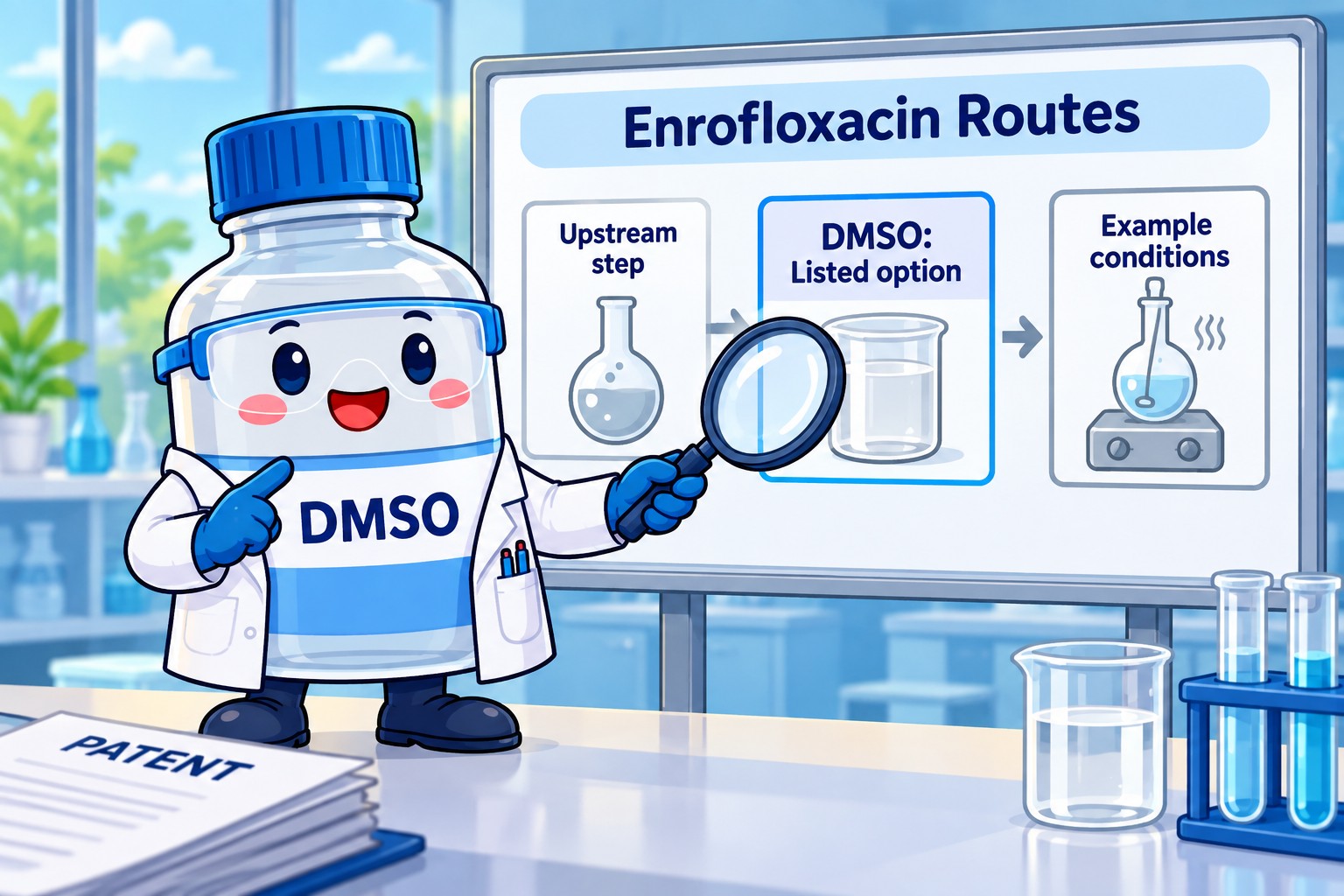
In a patent covering routes to enrofloxacin and related quinolones, DMSO is listed as an optional solvent for an upstream intermediate step. This is a useful route-development lead, but it is important to distinguish a solvent named in the claims from one demonstrated in a worked example, and to recognize that the final substitution in the route is described in a different medium.
- DMSO is among the solvents claimed for an upstream quinolone-intermediate stage.
- A listing in the claims is not the same as a worked example or a proven advantage.
- The final N-ethylpiperazine substitution is described separately with alcohol media.
Where DMSO appears in the route
Enrofloxacin is a fluoroquinolone veterinary antibiotic built through a quinolone core followed by introduction of the N-ethylpiperazine substituent. Patent CN104292159B includes DMSO among the solvents that may be used for an upstream stage in which an intermediate is prepared, before the later substitution that installs the piperazine group.
Listed in claims versus used in an example
Patents commonly claim a list of solvents that are considered suitable, while providing detailed worked examples for only some of them. A solvent that appears in such a list is supported as an option, but the patent does not necessarily report its yield, side products or preferred conditions, and it does not demonstrate that it performs better than the others. The DMSO listing in this route therefore establishes that DMSO is technically contemplated for the upstream step; it does not, on its own, establish improved yield, current commercial adoption or a requirement to use DMSO.
The final step is described in alcohol media
The substitution that introduces N-ethylpiperazine—the step most closely associated with the finished enrofloxacin structure—is described separately using alcohol media rather than DMSO. This means DMSO’s presence in an upstream listing should not be extended into a claim that DMSO is used for the final enrofloxacin step. Each stage has its own solvent description and should be treated independently.
Where solvents matter in quinolone synthesis
Fluoroquinolone routes combine two broad phases: construction of the bicyclic quinolone core through condensation and cyclization, and later substitution of a leaving group—commonly a chlorine at the 7-position—by an amine such as N-ethylpiperazine. Both phases involve substitution chemistry in which polar aprotic solvents can be useful because they dissolve ionic reagents and leave nucleophiles comparatively reactive. DMSO is listed for an upstream stage associated with preparing the intermediate, while the final piperazine substitution in the cited patent is described with alcohol media.
This pattern is worth understanding because it shows why DMSO keeps appearing in quinolone patents even when it is not the solvent of the final step: the upstream stages handle salts and polar intermediates for which DMSO is a credible medium. At the same time it sharpens the boundary—the listing supports DMSO for a specific stage and should not be generalized to the whole route or read as a claim about the finished enrofloxacin step.
This is a “listed option,” which is weaker evidence than a fully worked DMSO example. It is best treated as a starting point for laboratory comparison rather than as a validated process.
Using the lead in route development
A reasonable development approach takes the upstream step for which DMSO is listed and runs it in DMSO alongside the solvent used in the worked example, comparing conversion, selectivity, work-up and recovery under matched conditions. DMSO’s polar aprotic character can be advantageous for substitution chemistry and it dissolves many salts, but its high boiling point affects removal and recovery, which should be included in the comparison. This converts the patent listing into an evidence-based decision rather than an assumption.
Because the DMSO listing is upstream, the comparison should also confirm that the intermediate prepared in DMSO is compatible with every later stage, so a solvent choice made early does not complicate the alcohol-based final substitution or the downstream purification. Documenting conversion and impurity profiles for both media gives a clear, auditable and reliable basis for the decision. Running the comparison at more than one scale also reveals whether any DMSO advantage survives transfer from the laboratory.
Confirm DMSO for your quinolone intermediate
Share the upstream step and your grade requirements. We will match the solvent and provide the batch documentation.
Frequently asked questions
Does the patent demonstrate DMSO in a worked example?
DMSO is listed among claimed solvents for an upstream stage; the patent’s detailed examples and the final step use other media, so DMSO is an option rather than a demonstrated result.
Is DMSO used for the final piperazine substitution?
No. That step is described separately with alcohol media; DMSO belongs to an upstream listing only.
Does the listing prove DMSO gives a better yield?
No. A claims listing does not report comparative yield; that has to be established by side-by-side development work.
How should we use this information?
Treat DMSO as a candidate for the upstream step and compare it experimentally against the exemplified solvent, including work-up and recovery.
Why does DMSO appear in quinolone patents at all?
Upstream stages handle salts and polar intermediates for which polar aprotic DMSO is a credible medium, even where the final step uses alcohol.