
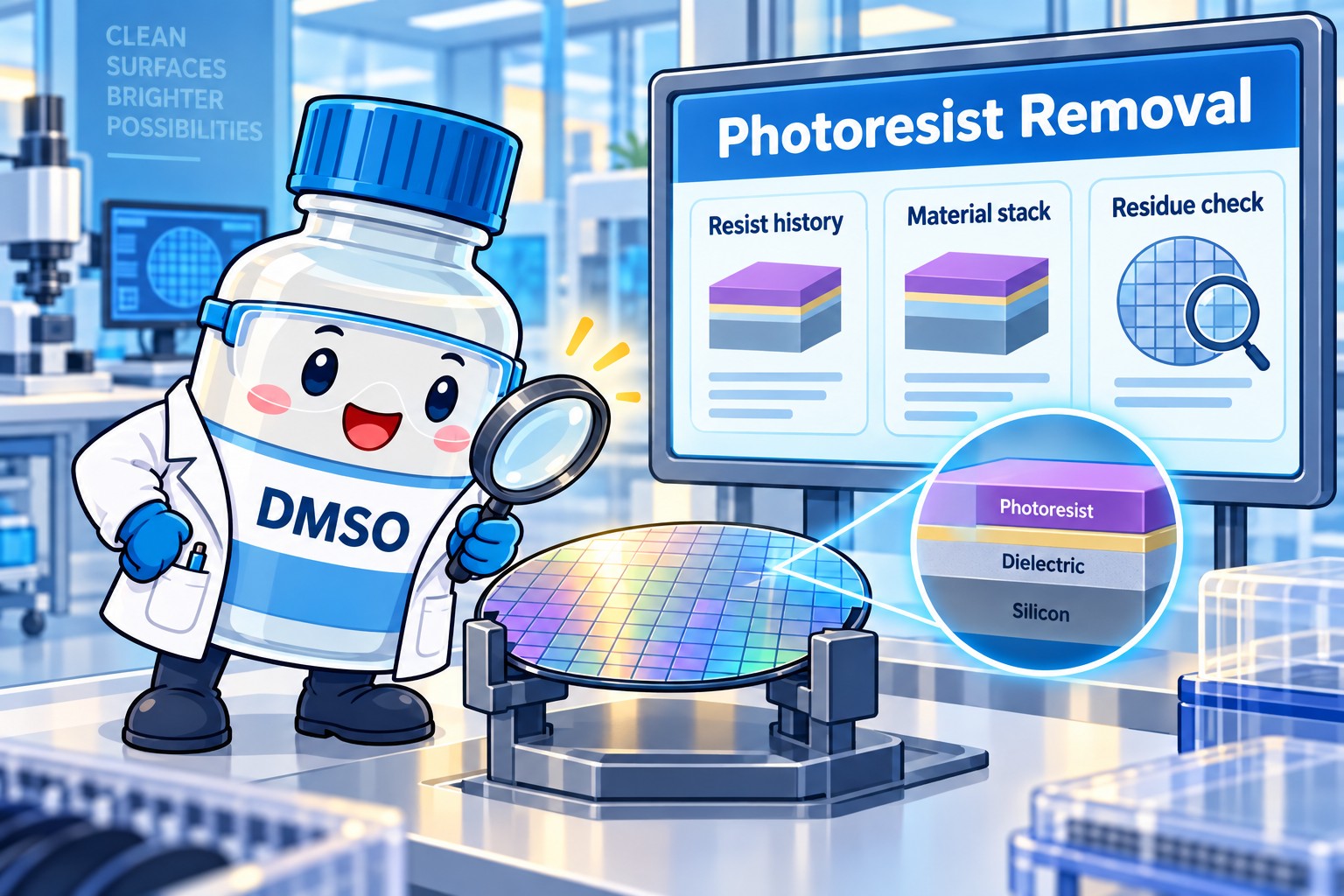
DMSO is widely used as a photoresist-stripping solvent in microelectronics. After a resist has served its lithography purpose, it has to be removed without leaving residue or attacking the substrate. Heated DMSO is one of the established solvent options for this step, and understanding what it does—and what it does not do—helps process engineers qualify it correctly.
- DMSO acts as a solvent-based stripper: it dissolves or lifts removable resist material.
- Results depend on the resist type and its processing history; hardened, cross-linked films may need other chemistry.
- Pure DMSO and formulated strippers are different products and should not be treated as equivalent.
Where DMSO fits in resist removal
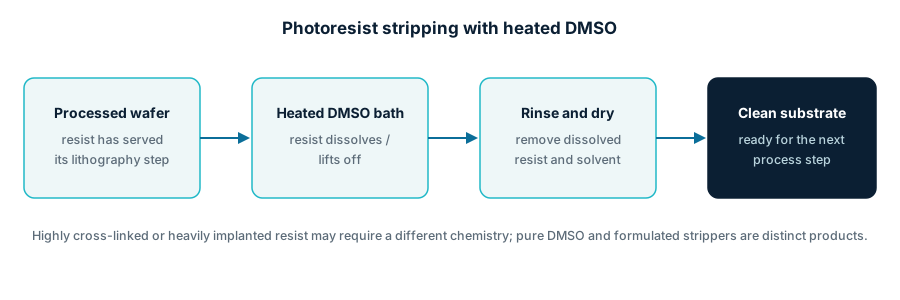
Photoresist stripping sits after the patterned film has been used for imaging, etching or implantation and is no longer needed. In a solvent strip, the wafer is exposed to heated DMSO so that the resist film softens, dissolves or lifts from the surface, followed by rinsing and drying. The MicroChemicals application note identifies heated DMSO among the solvent options for photoresist removal.
How DMSO removes resist
DMSO is a highly polar, aprotic solvent that mixes with water and many organic materials. In stripping, its function is physical dissolution and swelling of the resist rather than a synthesis reaction; it is not being used as an oxidation reagent here. Heating increases the rate at which the film is penetrated and removed, which is why the solvent is commonly used warm rather than cold.
The response of the resist depends on its chemistry. Films that remain largely soluble are removed relatively directly, while resists that have become highly cross-linked, or that have been hardened by high-dose implantation or aggressive plasma, can be much more resistant. In those cases the same DMSO bath may be slow or incomplete even if it works well on an unhardened film.
Resist types and their stripping behavior
Different photoresist families respond differently to DMSO. Conventional positive resists based on novolac with a diazonaphthoquinone sensitizer are commonly stripped with solvent after processing, as are many negative and chemically amplified films when they have not been severely hardened. Chemically amplified resists rely on acid-catalyzed deprotection; after imaging and post-exposure bake their solubility changes, and the ease of solvent removal depends on how far that chemistry has progressed.
The processing history often matters more than the nominal resist name. High-temperature bakes, deep-UV or electron-beam curing, high-dose ion implantation and aggressive plasma etching can cross-link or carbonize the upper layer, producing a crust that resists solvent penetration. Such films may need an added pretreatment, a formulated or amine-bearing stripper, or a dry (plasma) process before a final solvent clean.
Solvent strip versus dry strip
Wet solvent stripping and dry plasma ashing are complementary rather than interchangeable. Wet DMSO stripping is simple, low in ion damage and effective on soluble films, and it is often preferred where plasma exposure could damage sensitive layers or where metal compatibility favors a solvent route. Dry ashing oxidizes the resist and handles heavily hardened films well, but it exposes the wafer to plasma and can leave inorganic residue that still requires a wet clean. In many production flows the two are combined—a dry step removes the bulk of hardened resist and a DMSO-based wet step removes the remaining residue—so the question is not which is universally better, but which sequence fits the stack.
Pure DMSO versus formulated strippers
Pure DMSO is a single solvent, whereas formulated strippers may combine DMSO (or other solvents) with additives such as amines, co-solvents or corrosion inhibitors designed for specific resist types or metal compatibility. The two product categories can behave differently in stripping speed, residue and attack on sensitive layers. A result obtained with a formulated product should not be attributed to pure DMSO, and vice versa; the material actually used in qualification should match what is purchased for production.
Even a solvent that removes resist cleanly can affect exposed metals or dielectrics. Qualify stripping on the actual stack, and confirm the DMSO grade’s metal and particle specification for sensitive devices.
Process variables that determine results
Removal performance is governed by temperature, time, agitation, the condition of the bath and the resist’s processing history. A bath that is loaded with dissolved resist, or that has absorbed water over time, will not perform like fresh solvent, so bath life and change-out need to be defined. Because the appropriate settings are process-specific, they should be established on the real resist and stack rather than copied from a generic recommendation.
Selecting and qualifying the material
For routine stripping, an appropriate grade with a clear COA may be sufficient; for advanced or front-end processing, tighter control of water, metals and particles is required. A practical qualification runs the candidate DMSO on representative wafers, checks for residue and substrate attack after rinsing, and verifies that incoming batches meet the agreed specification. This connects the stripping process to the product specification described in our electronic-processing article.
An incoming-inspection step can confirm water content and, where required, metals and particles before the solvent reaches the tool; this catches batches that have shifted in transport or storage and keeps production aligned with the certificate.
Confirm DMSO for your stripping process
Share your resist type, stack and grade requirements. We will match the solvent and provide the batch COA.
Frequently asked questions
Is DMSO a solvent or a reagent in resist stripping?
In this application it is a solvent. It dissolves or lifts the resist film; it is not participating in a chemical synthesis as it does in activated-DMSO oxidation.
Why is DMSO usually heated for stripping?
Heating speeds penetration, swelling and dissolution of the resist, shortening the time needed for removal. The exact temperature and time are process-specific.
Will DMSO remove every photoresist?
No. Highly cross-linked, high-dose implanted or plasma-hardened films can resist DMSO and may require a formulated stripper or a different chemistry.
What is the difference between DMSO and a formulated stripper?
A formulated stripper adds co-solvents or additives for specific resists or metal compatibility. Performance, residue and compatibility can differ from pure DMSO.
How should a stripping bath be managed?
Control temperature, time and bath loading, and define change-out, because resist loading and absorbed water gradually reduce performance.
When should I use wet DMSO instead of plasma ashing?
Wet DMSO suits soluble films and avoids plasma exposure on sensitive layers; heavily hardened resist may need dry ashing first, followed by a DMSO wet clean.