
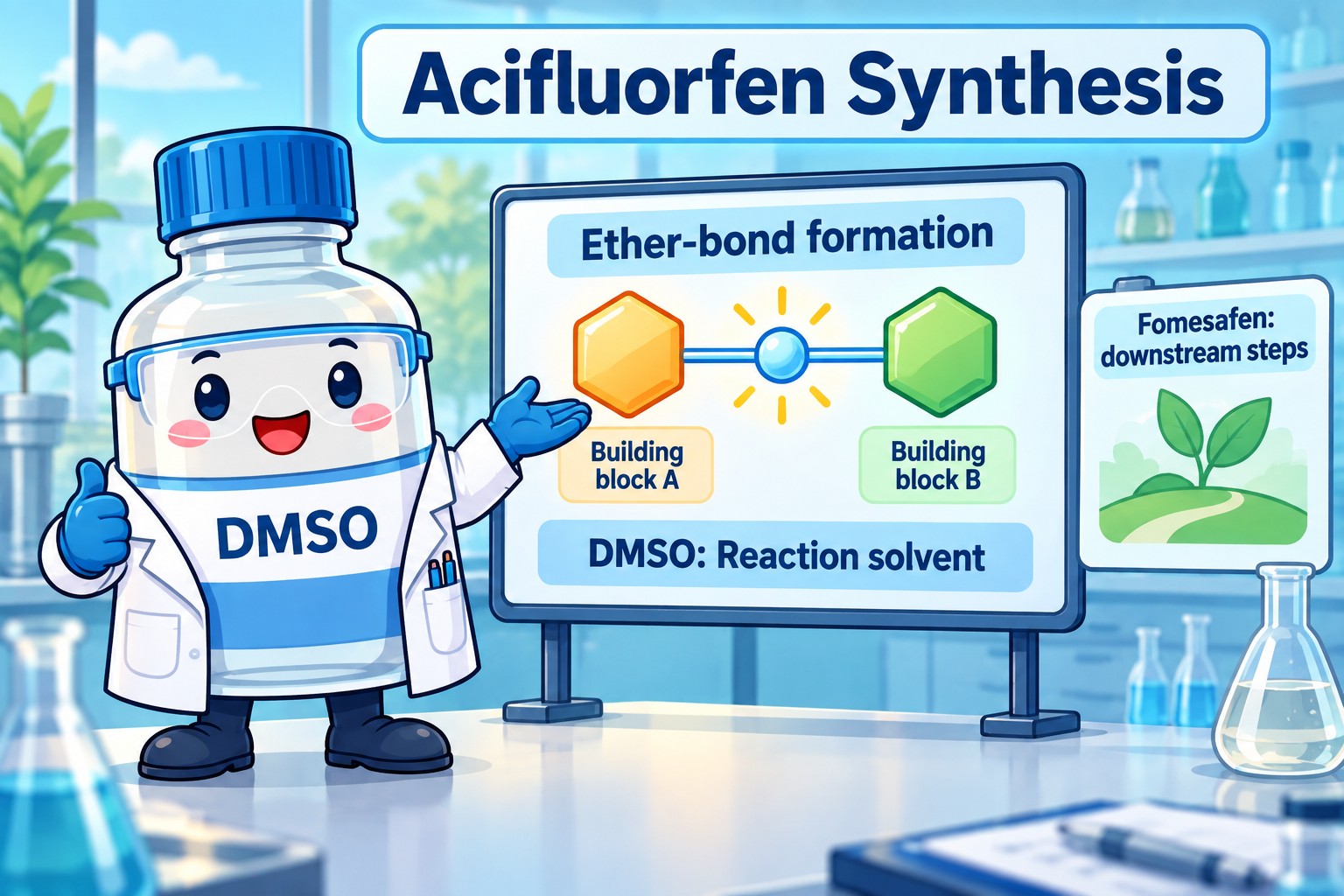
In a published acifluorfen route, DMSO is used as the reaction solvent for the step that forms the diaryl ether linkage. This is a nucleophilic aromatic substitution: an oxygen nucleophile from a phenolic component replaces a leaving group on an activated aromatic substrate. The choice of solvent affects how readily that substitution proceeds, and DMSO is one medium described in the patent.
- DMSO serves as the polar aprotic medium for diaryl ether (SNAr) formation.
- The cited patent also includes an alternative-solvent example, so DMSO is an option rather than a unique requirement.
- This upstream step does not establish DMSO use throughout the downstream fomesafen route.
The ether bond in the acifluorfen route
Acifluorfen is a diphenyl-ether herbicide, and its structure contains an Ar–O–Ar′ linkage that must be built during synthesis. In the process described by patent CN105601519A, a phenolic component reacts with an activated aromatic substrate in a DMSO-containing medium to construct that ether-linked intermediate.
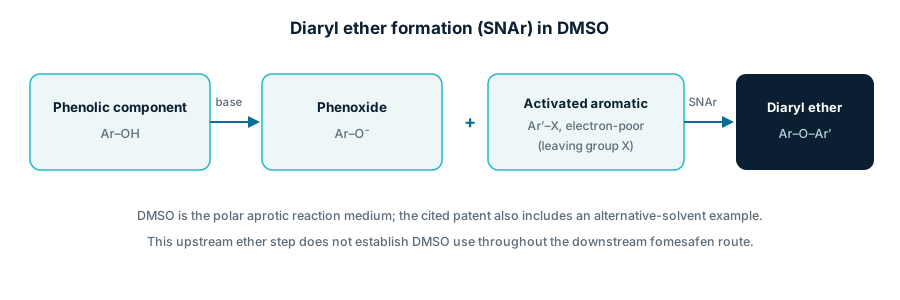
Role of DMSO in the SNAr step
In this reaction DMSO is the reaction medium, not a reagent that is consumed in the bond-forming chemistry. A base converts the phenol toward its phenoxide form, and the phenoxide attacks the electron-poor aromatic substrate, displacing the leaving group to give the diaryl ether. DMSO provides the liquid phase in which these components meet and react.
Why a polar aprotic solvent can help
SNAr reactions with anionic oxygen nucleophiles are often run in polar aprotic solvents because such solvents dissolve ionic components well without strongly hydrogen-bonding to and stabilizing the nucleophile. This can leave the phenoxide comparatively reactive toward the aromatic substrate. DMSO is one of a family of polar aprotic solvents used this way; whether it is the best choice in a given process depends on the substrates, base, temperature and downstream separation.
Reaction variables in the SNAr step
Several variables determine how cleanly the ether bond forms. The base and its equivalents control how much phenoxide is generated and whether the phenol is fully deprotonated; too little base leaves unreacted phenol, while the choice of base can also introduce water or salts. Temperature balances rate against side reactions, and the concentration of the substrates affects both throughput and the risk of undesired coupling. Because the leaving group on the activated aromatic is displaced during the reaction, its identity and the electron-withdrawing groups that activate the ring set the intrinsic difficulty of the substitution.
Water deserves particular attention in a DMSO SNAr. DMSO is hygroscopic and the medium can pick up water from wet reagents or open handling; water changes the solvation of the phenoxide and can favor hydrolysis of the activated substrate over the desired ether formation. Controlling the water content of the DMSO, and confirming it on the COA, is therefore a practical route-development lever rather than a paperwork detail.
| Factor | DMSO | Alternative solvent (per patent) |
|---|---|---|
| Nucleophile reactivity | Often high in polar aprotic medium | Depends on the solvent class |
| Water sensitivity | Hygroscopic; needs drying | Varies with solvent |
| Removal / recovery | High boiling; vacuum recovery typical | May strip more easily |
| Cost at scale | Higher solvent cost; recovery offsets it | Should be compared on total process cost |
The patent includes an alternative-solvent example. During route development it is worth comparing DMSO against that option on yield, work-up, recovery and cost rather than assuming DMSO is required.
Connection with fomesafen
Acifluorfen also appears as a starting material in a separate published process leading to fomesafen, described in US6790991B2. Those downstream transformations have their own reaction conditions and solvent choices. The use of DMSO in an upstream ether-forming step therefore does not establish that DMSO is used throughout a fomesafen synthesis; each stage has to be examined on its own.
Process considerations
At scale, the decision to use DMSO also involves its high boiling point and the means of separating and recovering it after the reaction. Because DMSO is not easily removed at low temperature under atmospheric pressure, recovery and work-up should be planned as part of the route rather than treated as an afterthought. Purity and water content of the DMSO should also be matched to the sensitivity of the chemistry and confirmed on the batch COA.
It is worth defining how salts and the displaced leaving group are removed in the work-up, since inorganic by-products can otherwise complicate phase separation or carry into the ether intermediate. A short side-by-side comparison of DMSO against the patent’s alternative solvent, at the same base loading and temperature, gives a defensible basis for the choice rather than relying on a single example. Tracing where DMSO is lost—in the work-up, on salts or in residues—also improves the recovery mass balance and makes the cost comparison more reliable.
Confirm DMSO for your ether-forming step
Send your reaction outline and grade requirements. We will match the solvent and provide the batch documentation.
Frequently asked questions
Is DMSO a reagent or a solvent in this step?
It is the reaction solvent. The ether bond is formed by the phenoxide and the activated aromatic substrate; DMSO is not consumed in that bond.
Why use a polar aprotic solvent for SNAr?
Polar aprotic solvents dissolve ionic components well while leaving the anionic nucleophile comparatively reactive, which can support the substitution.
Does the patent require DMSO?
No. It includes a DMSO-containing medium but also an alternative-solvent example, so DMSO is a listed option rather than a unique requirement.
Does this mean DMSO is used to make fomesafen?
Not by itself. The downstream fomesafen process has its own solvent choices; DMSO in an upstream ether step does not establish its use throughout.
What most affects the SNAr result?
Base equivalents, temperature, the activated substrate’s leaving group and the water content of the DMSO are the main levers; water can favor hydrolysis over ether formation.