
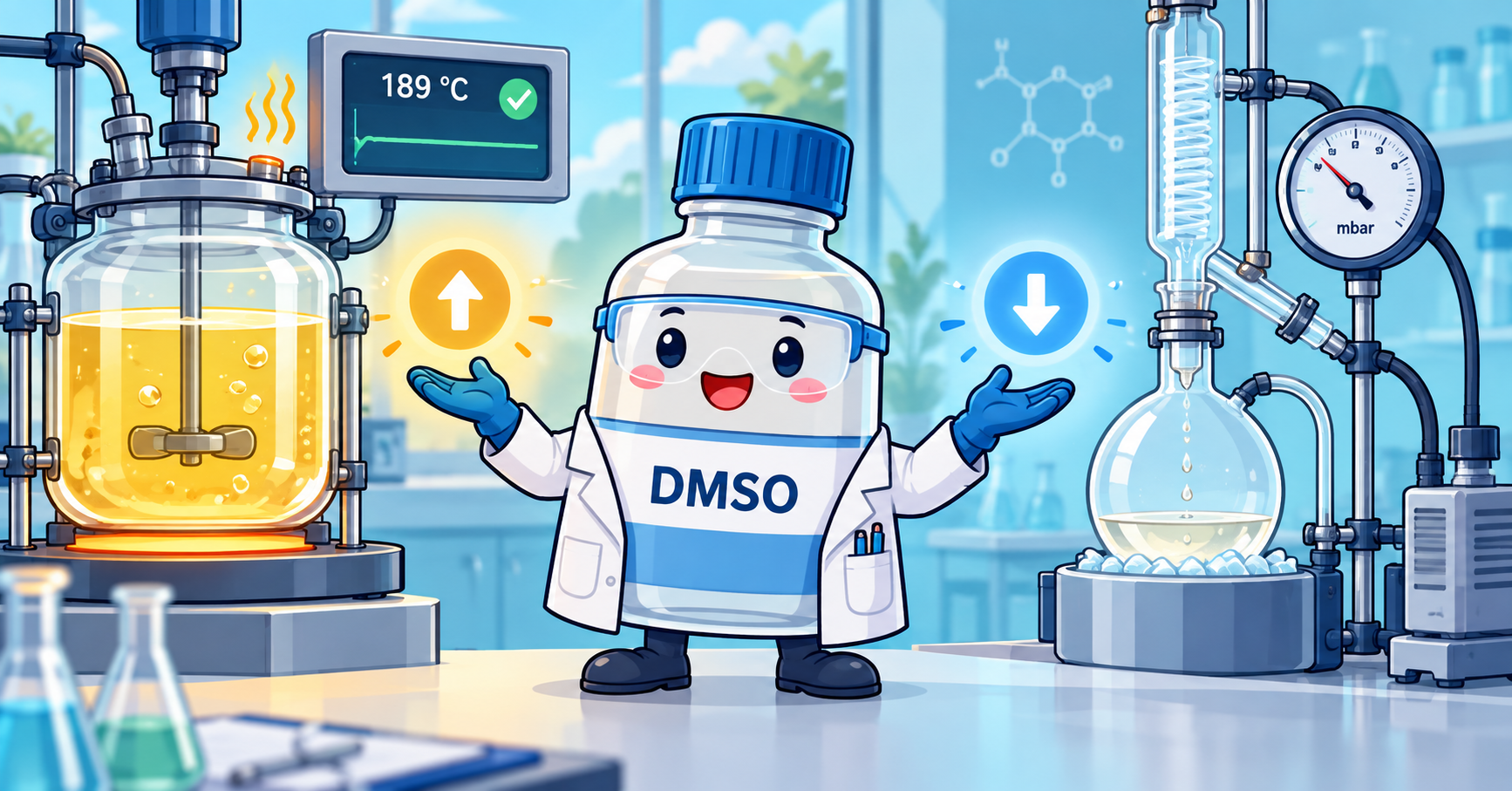
A high boiling point is neither simply an advantage nor simply a disadvantage. It widens the temperature window at the reactor and changes the engineering problem after the reaction is complete. The useful question is therefore not whether a high boiling point is good or bad, but whether the complete process, from charging and reaction through isolation and residual-solvent control, benefits from the solvent.
- DMSO’s boiling point near 189 C provides a wider sustained-heating window than lower-boiling polar solvents.
- The same property makes removal, solvent exchange and drying the harder part of the design.
- Screen conversion and selectivity together with isolation and recovery, not separately.
A wider operating window
DMSO boils at about 189 C, compared with about 153 C for DMF and lower still for acetonitrile or acetone. For reactions that need sustained heating, that gap provides headroom before reflux or solvent loss becomes limiting, while DMSO’s polarity supports many demanding organic and ionic systems. A wider window can simplify temperature control and reduce the rate at which solvent must be replaced during long operations. The benefit is real, but it belongs to the reaction stage of the process.
The downstream challenge
The property that helps at the reactor changes the engineering once conversion is complete. Removing DMSO by simple atmospheric evaporation is rarely the whole answer, because high temperatures can stress the product and consume energy, and DMSO’s affinity for many substances makes complete removal slow. Vacuum distillation, extraction, solvent exchange, crystallization behavior, thermal stability and recovery economics often have to be evaluated together rather than treated as an afterthought. A step that converts quickly but cannot be isolated cleanly is not genuinely efficient.
| Stage | What the high boiling point gives | What must be designed |
|---|---|---|
| Reaction | Wide sustained-heating window; low solvent loss | Thermal control and stability checks |
| Isolation | Less risk of accidental concentration | Vacuum, extraction or solvent exchange |
| Drying | – | Residual-solvent limits and drying time |
| Recovery | Condensable under vacuum | Purification and reuse qualification |
Evaluate reaction and workup together
A solvent screen is strongest when it measures conversion, selectivity and reaction time alongside phase separation, isolation, drying and solvent recovery. Designing the reaction first and addressing removal later is how an apparent reactor advantage becomes a production bottleneck. Trials should therefore record the complete sequence: how the product is separated, how much solvent remains, what energy and equipment the removal requires, and whether recovered solvent can be reused. For the physical data and vacuum-distillation detail behind DMSO removal, our related article on boiling point and recovery provides the numbers.
This article treats the boiling point as an engineering tradeoff across the whole process. The companion article covers the physical boiling data and vacuum recovery specifics in detail.
Where the balance usually falls
DMSO tends to be favored where the reaction benefits from a wide, high-temperature window and where recovery can be organized, such as closed processes that recycle solvent. It is less attractive where the product is heat-sensitive and must be freed of solvent quickly, unless an efficient exchange or crystallization route exists. Making that balance explicit at the screening stage, rather than discovering it during scale-up, is the practical value of thinking about the full process early.
Design the reaction and the workup together
Tell us the operating temperature, isolation route and residual limits, and we will match a grade and discuss recovery.
Frequently asked questions
Is DMSO’s high boiling point an advantage?
It is an advantage at the reactor, where it widens the heating window, and a challenge in isolation and drying. The net value depends on the whole process.
Can DMSO simply be boiled off after the reaction?
Atmospheric evaporation is rarely sufficient and can stress the product. Vacuum distillation, extraction or solvent exchange is usually designed instead.
How does DMSO compare with DMF on temperature?
DMSO boils about 36 C higher than DMF, giving a wider sustained-heating window but a harder removal task.
What should a solvent screen record?
Record conversion, selectivity and time together with isolation, drying, residual-solvent results and recovery economics so the full process is assessed.
When is DMSO the wrong choice on boiling point?
It can be the wrong fit where a heat-sensitive product must be freed of solvent quickly and no efficient exchange or crystallization route is available.