
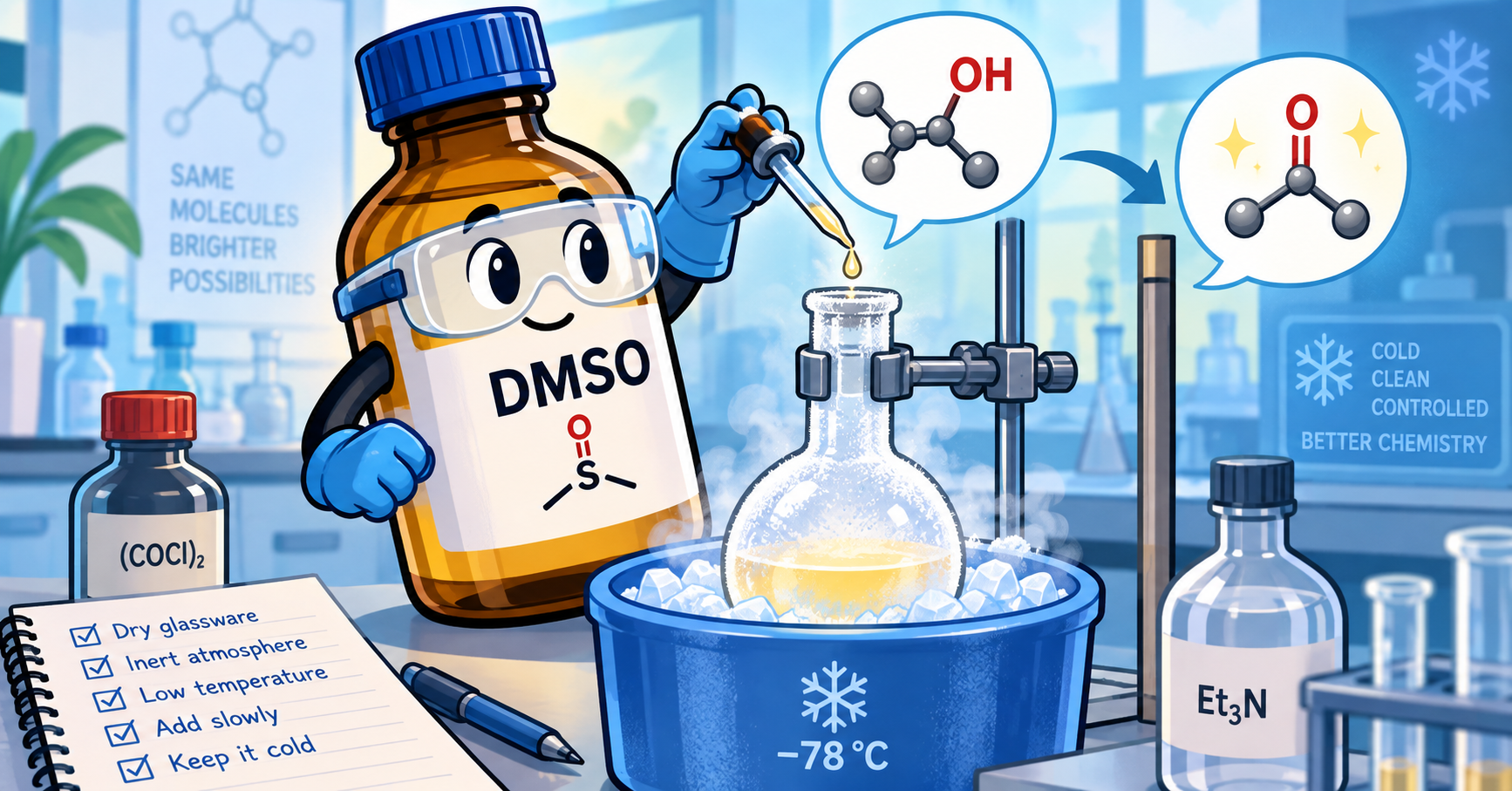
Most sourcing conversations begin with DMSO as a solvent. In some routes, however, DMSO becomes part of the reaction chemistry itself: it is consumed as the source of an oxygen atom or a sulfur-containing intermediate rather than simply carrying the reactants. The classic example is the Swern oxidation, and understanding that role changes both how the reaction is operated and how the DMSO is specified.
- In a Swern oxidation DMSO is activated, then converts an alcohol to an aldehyde or ketone; it is a reagent, not a medium.
- The method is chromium-free and suits sensitive molecules, but has a demanding operating window.
- Assay, water and trace impurities influence consistency, and the DMSO specification should be tied to the chemistry.
The Swern oxidation sequence
In a Swern oxidation, DMSO is first activated with oxalyl chloride at low temperature, forming a reactive intermediate and releasing gases. The alcohol is then introduced and reacts with the activated DMSO, after which a base, typically triethylamine, completes the conversion to the corresponding aldehyde or ketone. Throughout this sequence DMSO is a key reagent in the oxidation, and the sulfur-containing by-products are derived from it. This distinguishes the operation from a reaction where DMSO merely provides the liquid phase.
Why the process conditions matter
This chromium-free method can be attractive for sensitive molecules because it avoids metal oxidants, but its operating window deserves careful attention. Temperature control is critical, particularly during activation, and dry handling, addition rate and gas evolution all affect safety and reproducibility. The quench strategy and the handling of sulfur-containing by-products influence the workup and the quality of the isolated product. These features become more demanding during scale-up, where heat removal and gas handling cannot be treated as laboratory details.
| Process element | Why it matters | What to control |
|---|---|---|
| Activation | Forms the reactive species | Temperature and addition rate |
| Gas evolution | Affects safety and equipment | Venting and scale of operation |
| Base addition | Completes the oxidation | Timing and temperature |
| Quench and workup | Removes sulfur by-products | Washes and isolation route |
Connecting the DMSO specification to the chemistry
When DMSO participates in the reaction, its specification matters more directly. Assay determines how much active reagent is present, water content affects activation and side chemistry, and trace impurities can influence the impurity profile of a sensitive product. Packaging size and storage practice also affect consistency, because DMSO is hygroscopic and water uptake changes after containers are opened. The material should therefore be specified against the reaction’s needs rather than treated as a generic solvent purchase.
Swern uses oxalyl chloride, but DMSO can be activated by other agents to perform similar oxidations, including routes used in specific agrochemical syntheses. The principle, DMSO as reagent, is shared even where the activator differs.
From laboratory chemistry to reliable supply
A literature reaction is only the starting point. A robust manufacturing process combines reaction performance, safe operation, impurity control, workup design and a dependable raw-material specification, and it confirms that the DMSO grade can be supplied consistently. Documented procedures, such as the Swern protocols collected in Organic Syntheses, provide a reliable basis for development before the route is adapted to the target molecule and scale.
Match DMSO to a controlled oxidation
Tell us the activation route, scale and moisture limit, and we will discuss grade, supply format and documentation.
Frequently asked questions
Is DMSO consumed in a Swern oxidation?
Yes. DMSO is activated and participates directly in converting the alcohol, forming sulfur-containing by-products, so it functions as a reagent rather than an inert solvent.
Why is Swern operated at low temperature?
The activated intermediate is temperature-sensitive, and low temperature during activation and addition supports selectivity and safety.
Is Swern the only DMSO-based oxidation?
No. DMSO can be activated with different agents to oxidize alcohols; the specific route depends on the substrate and process.
Why does water content matter here?
Because DMSO is acting as a reagent, water can affect activation and side chemistry; controlling moisture supports consistent results, and DMSO is hygroscopic.
Does the method use chromium?
No. A practical advantage of Swern and related DMSO oxidations is that they avoid chromium-based oxidants, which is valuable for sensitive products.