
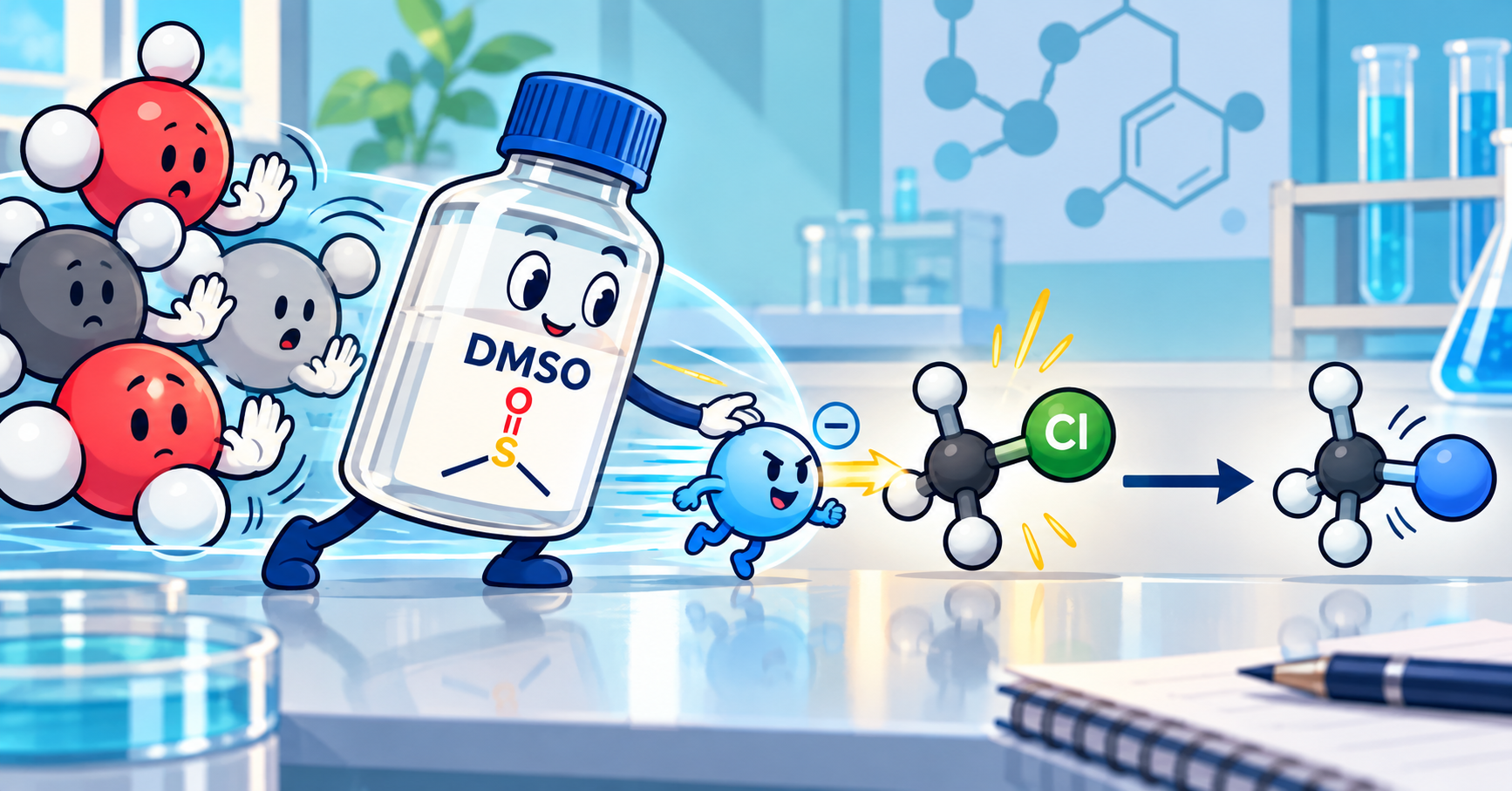
Choosing a solvent is not a neutral decision. In many substitution reactions the solvent changes how strongly ions interact, and that can change reaction rate, selectivity and the impurity profile. DMSO is one of the solvents most often evaluated when an anionic nucleophile needs to stay reactive, but it is not a universal shortcut, and the same conditions that accelerate conversion can complicate the workup.
- DMSO is polar aprotic: it dissolves ionic material without the strong hydrogen-bond donation of alcohols or water.
- That environment can keep an anionic nucleophile reactive in SN2 and activated aromatic substitutions.
- Sterics, base, water, temperature and isolation still control the outcome and should be screened together.
Why the solvent environment matters
DMSO can dissolve many polar and ionic materials while avoiding the strong hydrogen-bond donation typical of alcohols or water. In a protic solvent, an anionic nucleophile is surrounded by a shell of hydrogen-bonded solvent that must be shed before it can attack, which dampens its reactivity. In DMSO the anion is less strongly solvated on its reactive face and is often more available, which is why DMSO is evaluated for SN2 reactions and activated aromatic substitutions. The cation, meanwhile, is strongly coordinated by DMSO’s oxygen, helping keep the salt in solution.
Why DMSO is not a universal shortcut
The solvent does not remove the other determinants of the reaction. Steric hindrance, leaving-group ability, base choice, water content, temperature and substrate solubility still control conversion and selectivity, and a more polar medium can also strengthen competing pathways. A faster conversion is valuable only if the product can be isolated cleanly; if solvent removal or crystallization was not designed from the start, the apparent rate advantage can be lost in a difficult workup.
| Factor | What it affects | What to record |
|---|---|---|
| Solvent environment | Nucleophile availability | Conversion versus comparison solvents |
| Base & water | Side reactions and selectivity | Impurity profile |
| Sterics & leaving group | Reaction pathway | Reaction time and yield |
| Isolation route | Crystallization and drying | Recovery and residual solvent |
What a process screen should compare
A useful screen measures reaction time and conversion, selectivity and impurity formation, isolation and crystallization behavior, solvent recovery and waste handling, and final residual-solvent control. Comparing DMSO against the solvent it might replace on these terms, rather than on rate alone, shows whether the process as a whole benefits. The strongest solvent decision connects reaction performance with downstream process performance, including how the high-boiling solvent will be removed or recycled.
The general solvent properties of DMSO are documented in PubChem, and published process literature reports its use in substitution steps; confirm the specific behavior in the target reaction rather than extrapolating.
Applying the principle
DMSO tends to be favored where a genuinely anionic nucleophile is the rate-limiting feature and where the substrate and salts dissolve well, and where the workup can accommodate a high-boiling solvent. It offers less advantage where the reaction is governed by steric hindrance or where a protic environment is needed for selectivity. A short, well-designed trial that records the complete process is the most reliable way to decide.
Evaluate DMSO for your substitution
Send the substrate, nucleophile, base and isolation route, and we will discuss assay, moisture limit, packaging and destination.
Frequently asked questions
Why do nucleophiles often react faster in DMSO?
As a polar aprotic solvent, DMSO does not strongly hydrogen-bond to the anionic nucleophile, leaving it more available to attack than in protic solvents.
Does DMSO guarantee a cleaner SN2 reaction?
No. Steric hindrance, leaving group, base, water and temperature still govern selectivity, and the more polar medium can strengthen competing pathways.
Why might a faster reaction be harder to work up?
DMSO is high boiling and strongly solvating, so removal and crystallization require planning; a rate advantage can be lost without a designed isolation route.
What should the screen measure?
Measure conversion and time, selectivity and impurities, isolation behavior, recovery and residual solvent so the whole process is assessed.
Does DMSO coordinate the cation as well?
Yes. DMSO strongly coordinates cations through oxygen, which helps keep salts dissolved while the anionic nucleophile remains comparatively reactive.