
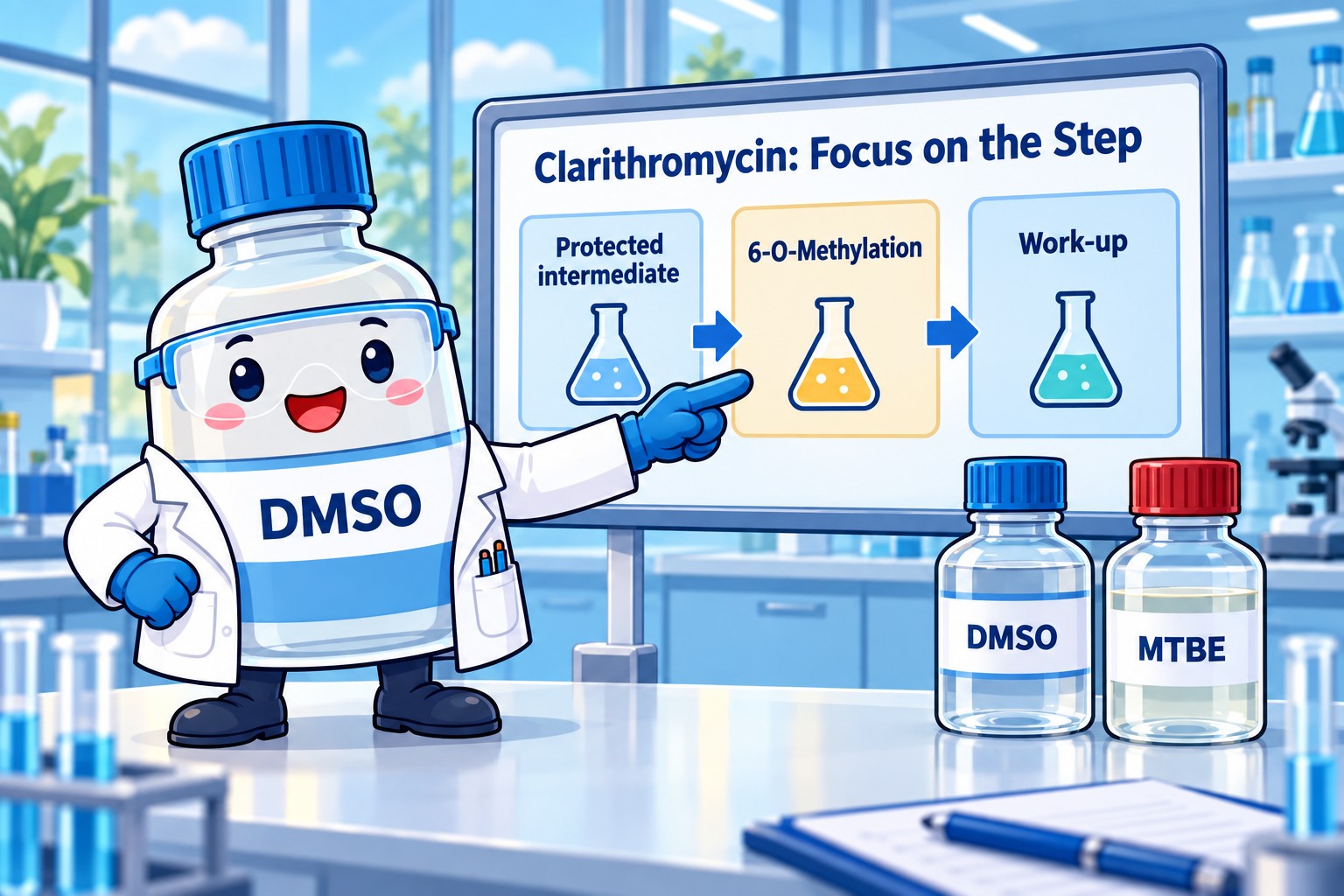
Clarithromycin is a 6-O-methylated erythromycin derivative, and installing that methyl group at the correct hydroxyl is one of the defining steps of its synthesis. In a published route the 6-O-methylation of a protected erythromycin oxime derivative is carried out in a mixed DMSO / methyl tert-butyl ether (MTBE) medium, with methyl p-toluenesulfonate supplying the methyl group and potassium hydroxide acting as the base. In this step DMSO functions as the reaction solvent.
- DMSO is the reaction medium for the 6-O-methylation, run together with MTBE.
- The methyl group comes from methyl p-toluenesulfonate; DMSO is not the methylating reagent.
- Selectivity for the 6-O position depends on protection, base and the mixed-solvent system.
The 6-O-methylation step
The erythromycin framework contains several hydroxyl groups, so direct methylation would give mixtures. The published route first protects or masks reactive positions—working through an oxime derivative—so that methylation can be directed toward the 6-O position. Patent CN102718821B describes the DMSO/MTBE medium used for this methylation.
Role of DMSO and MTBE
DMSO provides a polar medium in which the base, the methylating reagent and the protected macrolide can interact, while MTBE contributes a less polar phase. The mixed system is used to tune solubility and selectivity rather than simply to dissolve the substrate. As a polar aprotic solvent DMSO can support deprotonation of the target hydroxyl so that the resulting alkoxide can attack the methylating reagent, while MTBE helps shape the environment in which that occurs.
At scale the mixed medium also affects charging and work-up. Potassium salts formed during methylation can be poorly soluble in a purely organic phase, and the DMSO fraction helps keep the medium workable, while the MTBE fraction eases later separation and washing. Balancing the two solvents therefore influences not only selectivity but also salt handling, phase separation and the ease with which the methylated intermediate is isolated and carried into deprotection. These practical effects are part of why the route retains the mixed system rather than a single solvent.
Solvent, not methylating reagent
A common point of confusion is whether DMSO contributes the methyl group. It does not. The methyl is supplied by methyl p-toluenesulfonate (methyl tosylate), an alkylating agent whose methyl group is transferred to the 6-oxygen under basic conditions. Potassium hydroxide generates the reactive alkoxide; DMSO hosts the reaction but is not itself the source of the installed methyl. Keeping these roles straight matters when interpreting equivalents and when troubleshooting methylation efficiency.
Why selectivity is the central challenge
Macrolides are dense with functional groups. The erythromycin framework presents hydroxyls at several positions along with a carbonyl and—in the protected precursor—an oxime, so the chemistry must discriminate among sites that are nominally similar. The oxime protection and the DMSO/MTBE medium exist precisely to widen the reactivity difference between the 6-O hydroxyl and the other positions so that methyl tosylate reacts where intended.
Even with protection, the process must be controlled against over-methylation and degradation. Base equivalents determine how much target hydroxyl becomes alkoxide; excess base can deprotonate other positions or promote breakdown of the sensitive macrolide, while too little leaves low conversion. Temperature moderates methylation and side reactions, and the DMSO/MTBE ratio changes both salt solubility and the environment around the substrate. These variables are optimized together, and the patent’s worked examples report the conditions under which the selective product is obtained.
Excess water can weaken deprotonation and reduce methylation, while the strong base must be managed on a sensitive macrolide. Controlling DMSO water content and base addition supports both conversion and selectivity.
Process considerations
The main challenges are selectivity and the stability of the protected intermediate. Base strength and addition, temperature and the DMSO/MTBE ratio all influence the balance between the desired 6-O-methyl product, methylation at other positions and degradation. After the reaction, DMSO’s high boiling point means its removal and recovery are typically done under reduced pressure, and the work-up has to separate the tosylate-derived salts and the solvent mixture. The DMSO grade should have assay and water content appropriate to the chemistry and be confirmed on the batch COA. Recording the methylation outcome and side-product profile across early batches also helps lock in a robust operating window before larger campaigns.
Confirm DMSO for your methylation step
Share your reaction outline and grade requirements. We will match the solvent and provide the batch documentation.
Frequently asked questions
Does DMSO supply the methyl group in clarithromycin?
No. The methyl comes from methyl p-toluenesulfonate; DMSO is the reaction solvent, and potassium hydroxide is the base.
Why is MTBE used together with DMSO?
The mixed DMSO/MTBE medium tunes polarity and solubility, helping direct methylation toward the 6-O position on the protected intermediate.
Why is protection needed first?
The macrolide has several hydroxyl groups; protecting or masking other positions lets methylation be directed to the 6-O oxygen rather than giving a mixture.
How is DMSO removed afterward?
Because of its high boiling point, DMSO is usually separated under reduced pressure, with salts from the methyl tosylate removed in the work-up.
What causes methylation at the wrong position?
Inadequate protection, excess base, or an unsuitable solvent ratio can deprotonate other hydroxyls and give side products; selectivity is optimized across protection, base and medium.