
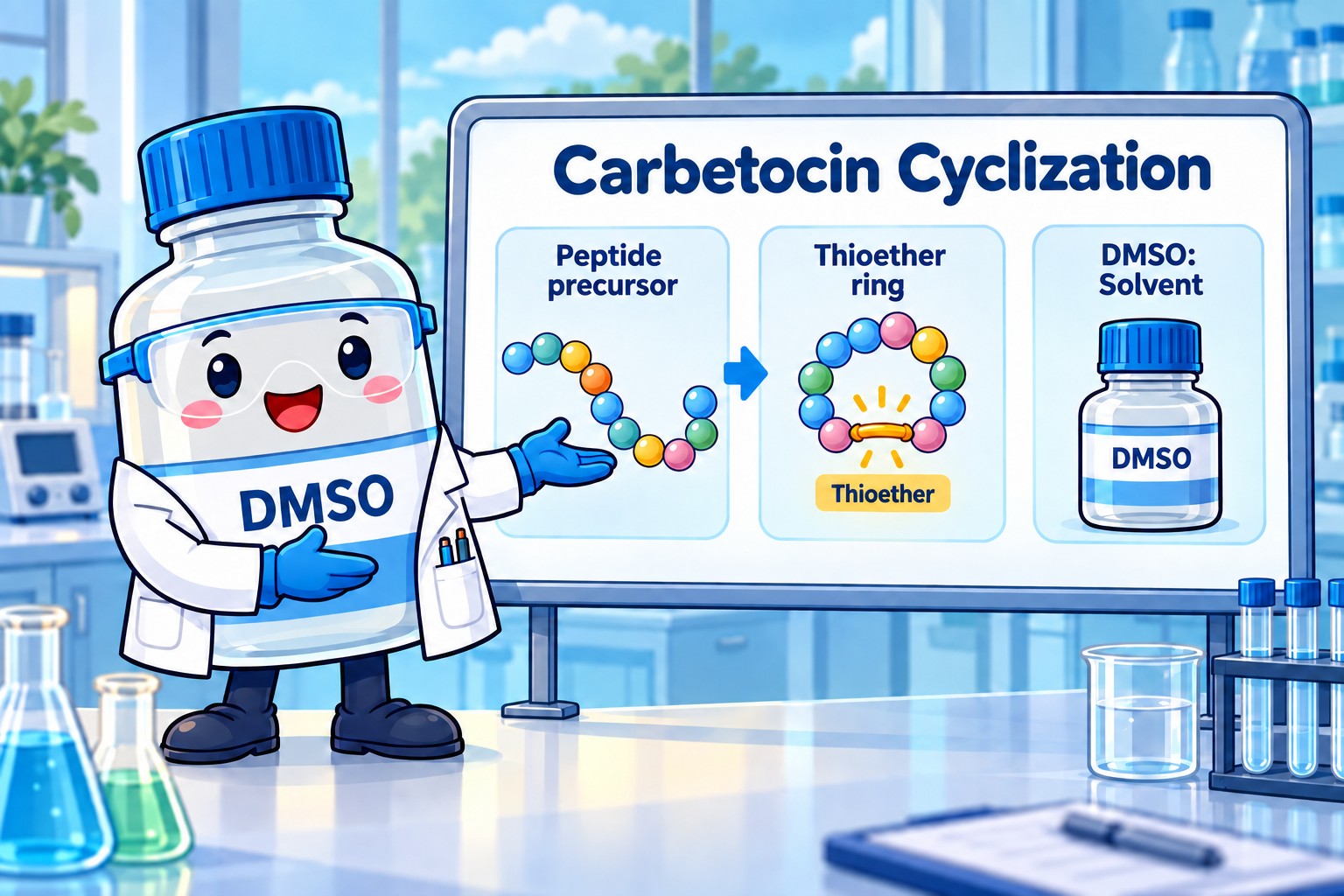
Carbetocin is a modified oxytocin-like peptide that contains a ring closed through a thioether linkage. In a published process the peptide precursor is dissolved in DMSO and cyclized in the liquid phase in the presence of an organic base. Here DMSO acts as the dissolution medium and reaction solvent; it is not described as an oxidant that forms a disulfide bond.
- DMSO dissolves the precursor and serves as the medium for liquid-phase cyclization.
- The resulting ring contains a thioether linkage, not a disulfide bond.
- DMSO is not acting as a disulfide-forming oxidant in this route.
The cyclization step
Ring closure is a critical operation in peptide manufacturing because the linear precursor must fold and react intramolecularly rather than coupling to other peptide chains. Patent CN115785225A describes dissolving the precursor in DMSO and carrying out the cyclization in the presence of an organic base, after which the cyclic product is carried forward into isolation and purification.
Role of DMSO
Peptide precursors can be difficult to dissolve, and DMSO is valued for its ability to dissolve a wide range of organic and polar materials. In this step it provides a homogeneous liquid phase in which the precursor, the organic base and the reactive groups can meet, supporting the intramolecular reaction that closes the ring. Its role is therefore that of a polar reaction solvent rather than a chemically consumed reagent.
Thioether, not disulfide
An important distinction is the type of bond that closes the ring. The carbetocin ring is closed through a thioether linkage (a sulfur–carbon bond built into the modified structure), rather than through the disulfide bond (S–S) found in some other peptide rings. Disulfide formation is typically an oxidation that links two cysteine thiols, whereas the cited cyclization builds the thioether under basic conditions. Consequently DMSO is not functioning here as a disulfide-forming oxidant, and describing the step as oxidative disulfide closure would misrepresent the chemistry.
Folding, dilution and the intramolecular bias
Cyclization is governed by effective molarity: when the two reactive ends of one chain are held close together, intramolecular closure is favored, while at high overall concentration separate chains encounter one another and can couple into dimers or oligomers. For this reason peptide ring closures are often run under dilute conditions, or with slow addition of the precursor or base, so that the reactive species is kept at low concentration and consumed intramolecularly as it forms.
The conformation of the precursor also matters. A chain that pre-organizes the chain—bringing the reactive sulfur and the site it attacks into proximity—cyclizes more readily and reliably than one that must first adopt an unfavorable shape. The organic base in the cited process establishes the conditions under which the thioether-forming reaction proceeds, while DMSO dissolves the precursor and allows the chain the mobility it needs to reach the reactive conformation. Adjusting concentration, base and addition order is therefore how the monomeric cyclic product is favored over intermolecular material.
Intramolecular ring closure competes with intermolecular coupling. Concentration, addition order and base are typically controlled—often favoring dilute conditions—to favor the monomeric cyclic product.
Process considerations
The principal challenges are complete dissolution of the precursor, selectivity of the intramolecular reaction, and avoidance of intermolecular or side products. The choice and amount of organic base, the concentration of the precursor, temperature and addition order all influence the result, and the cyclic product must then be separated and purified. As in other DMSO processes, water content should be controlled—DMSO is hygroscopic—and solvent removal and recovery are generally done under reduced pressure because of DMSO’s high boiling point. The grade and COA should match the requirements of peptide manufacturing.
Downstream of cyclization, the crude product typically contains unreacted precursor, salts and any intermolecular material and is purified by the usual peptide methods, often including preparative chromatography. Tracking the cyclic product and the dimer/oligomer fraction through reaction and work-up helps determine whether a low isolated yield originates in the cyclization or in purification losses. Because DMSO is high-boiling, its complete removal before chromatography or isolation should also be confirmed so residual solvent does not carry into the purified peptide. Where odor or volatile residues are a concern during vacuum removal, the condenser and vent treatment should be sized accordingly.
Confirm DMSO for peptide cyclization
Share your cyclization step and grade requirements. We will match the solvent and provide the batch documentation.
Frequently asked questions
Is the carbetocin ring a disulfide bond?
No. It is closed through a thioether linkage built under basic conditions; it is not an S–S disulfide between two cysteines.
Is DMSO an oxidant in this step?
No. DMSO dissolves the precursor and hosts the cyclization as a solvent; it is not described as a disulfide-forming oxidant.
Why use DMSO for peptide cyclization?
DMSO dissolves polar peptide precursors well and provides a homogeneous phase for the intramolecular ring closure.
How is oligomerization avoided?
Concentration, base and addition order are controlled, often using dilute conditions or slow addition, to favor intramolecular closure over intermolecular coupling.
Why does the precursor’s conformation matter?
A chain that pre-organizes its reactive ends together cyclizes more readily; DMSO gives the precursor mobility to reach that reactive shape.