
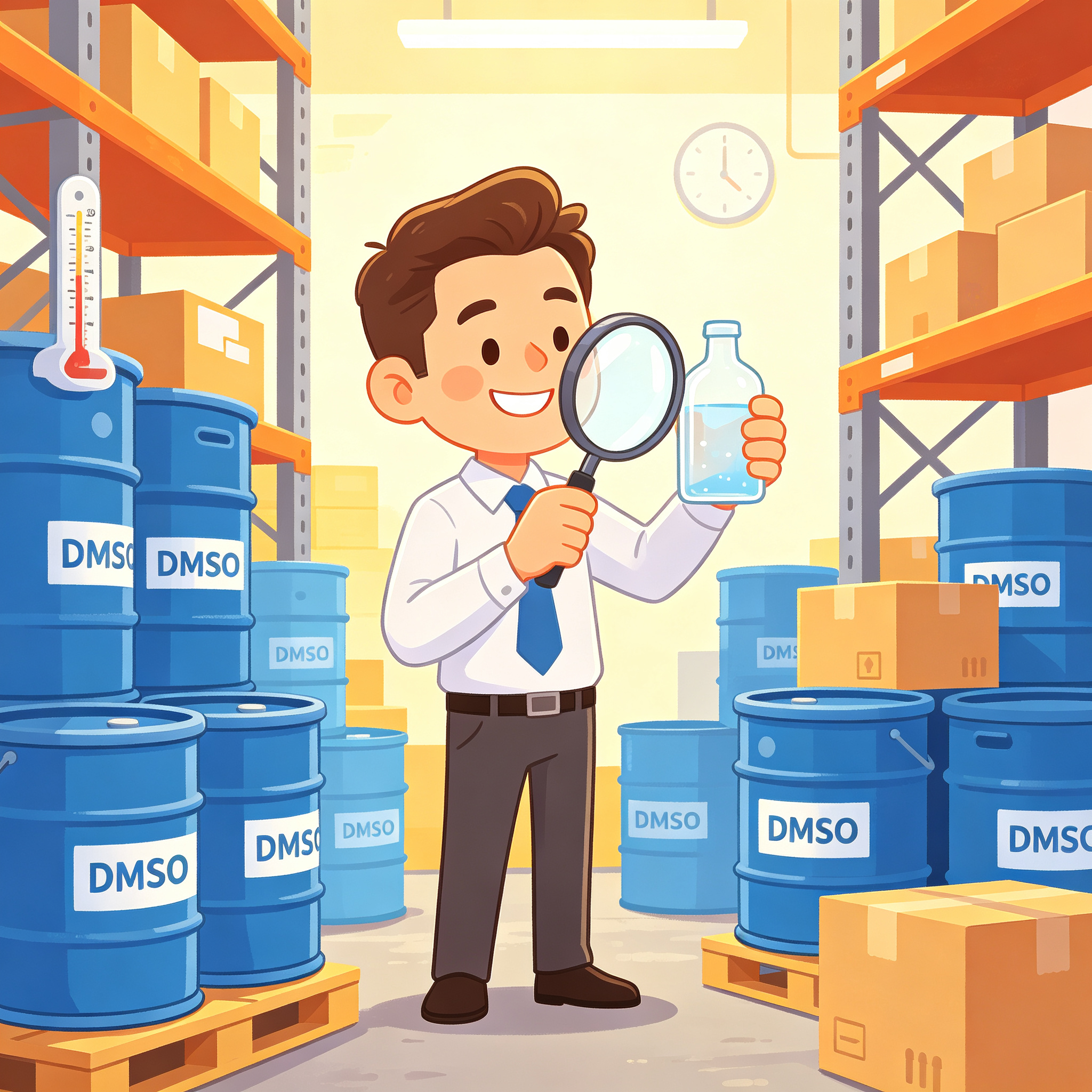
Grade names such as industrial, pharmaceutical or electronic are useful shorthand, but they do not by themselves establish whether a product suits a process. Two suppliers can use the same grade label against different specifications, methods and limits. The reliable way to compare DMSO is to set the label to one side and examine the agreed specification, the analytical methods, the batch documentation and the intended application.
- Compare the written specification and test methods, not the grade label or headline purity.
- Review purity together with moisture, residue, acidity or alkalinity, optical properties and application-specific limits.
- Distinguish a specification limit from a single batch result, and confirm pharmacopeial or standard compliance in writing.
Start from the grade definition
A grade is only meaningful when it points to a defined specification. Industrial grade generally targets general synthesis, formulations and cleaning where the tightest trace limits are not required; pharmaceutical grade is supplied against tighter controls and the documentation expected in regulated work; electronic grade adds tight metal, particle and water control for device processing. These are tendencies, not universal definitions, and the actual limits vary between suppliers and standards.
Pharmacopeial compliance, such as a named monograph, and suitability for a regulated application must be confirmed through the applicable documentation before purchase. A label that says a grade is suitable is not equivalent to a certificate showing that the required tests were performed within limits.
Compare the parameters that matter
Purity should be reviewed alongside the parameters that drive process performance. A parameter is meaningful only when its unit, test condition, method and acceptance limit are clear; “low moisture” or “high purity” without those details cannot be compared between suppliers. The table below groups the parameters commonly reviewed when grades are compared and why each matters.
| Parameter group | Why it matters | Typical method |
|---|---|---|
| Assay / purity | Confirms DMSO content and other organics. | Chromatography, % |
| Moisture | Water affects sensitive reactions and bath life. | Karl Fischer, ppm or % |
| Acidity / alkalinity | Influences stability and can catalyze side reactions. | Titration, mg KOH/g |
| Optical properties | UV absorbance and color indicate residuals such as sulfone. | UV/visible; APHA color |
| Non-volatile residue | Residue remains after evaporation. | Gravimetry, ppm or mg/L |
| Metals (where required) | Critical for electronic and some fiber processes. | ICP-MS, ppb, named elements |
Review the documents before purchase
Before committing, confirm the supply specification and its revision, review a representative COA and verify the analytical methods. A COA reports how a particular batch performed against the specification; the two should not be confused, because a single good batch does not redefine the guaranteed limits. Define your own acceptance criteria for the intended application and check that the offered product meets them, rather than adopting the supplier’s generic grade as your requirement.
Appearance and odor cannot verify purity or suitability, and freezing behavior is not a valid quality test either. These observations may prompt a question, but the documented results are what support a purchasing decision.
Plan packaging, storage and handling
DMSO is hygroscopic, so packaging integrity and handling controls directly affect the moisture result. Confirm the offered package, net weight, closure, storage guidance and any destination-specific documentation with the quotation. DMSO may also solidify in cool conditions; when thawing is needed, follow the product-specific SDS and supplier instructions, and do not use freezing behavior as evidence of purity. Containers should remain sealed to protect the very parameters that distinguish a tighter grade.
A practical sourcing checklist
- Describe the application and the limits that affect the process.
- Compare the proposed specification and methods against those requirements.
- Request the current SDS, specification and a representative COA.
- Confirm grade, packaging, quantity, destination and document needs in writing.
When two suppliers offer “pharmaceutical grade,” compare the actual parameter limits and methods rather than the name. The grade that looks cheaper may simply guarantee less.
Compare grades against your process
Send the application and critical limits. We will match a specification and provide the documentation.
Frequently asked questions
Is pharmaceutical grade always tighter than industrial grade?
Generally it is supplied against tighter controls and more documentation, but the exact limits are defined by each specification. Compare the written parameters rather than assuming the label guarantees a fixed difference.
What is the difference between a specification and a COA?
The specification states the guaranteed limits and methods; the COA reports the measured results of one batch. A good batch result does not replace the guaranteed specification.
Can I confirm pharmacopeial compliance from the product name?
No. Compliance must be shown against the applicable monograph and confirmed in the batch documentation before purchase.
Does packaging affect the grade comparison?
Yes. Because DMSO absorbs water, unsealed or unsuitable packaging can change moisture and other results after delivery. Confirm packaging and closure as part of the comparison.
Should I simply buy the highest grade?
No. The correct grade matches the process requirements. Buying tighter limits than the application needs adds cost without benefit, while under-specifying creates risk.