
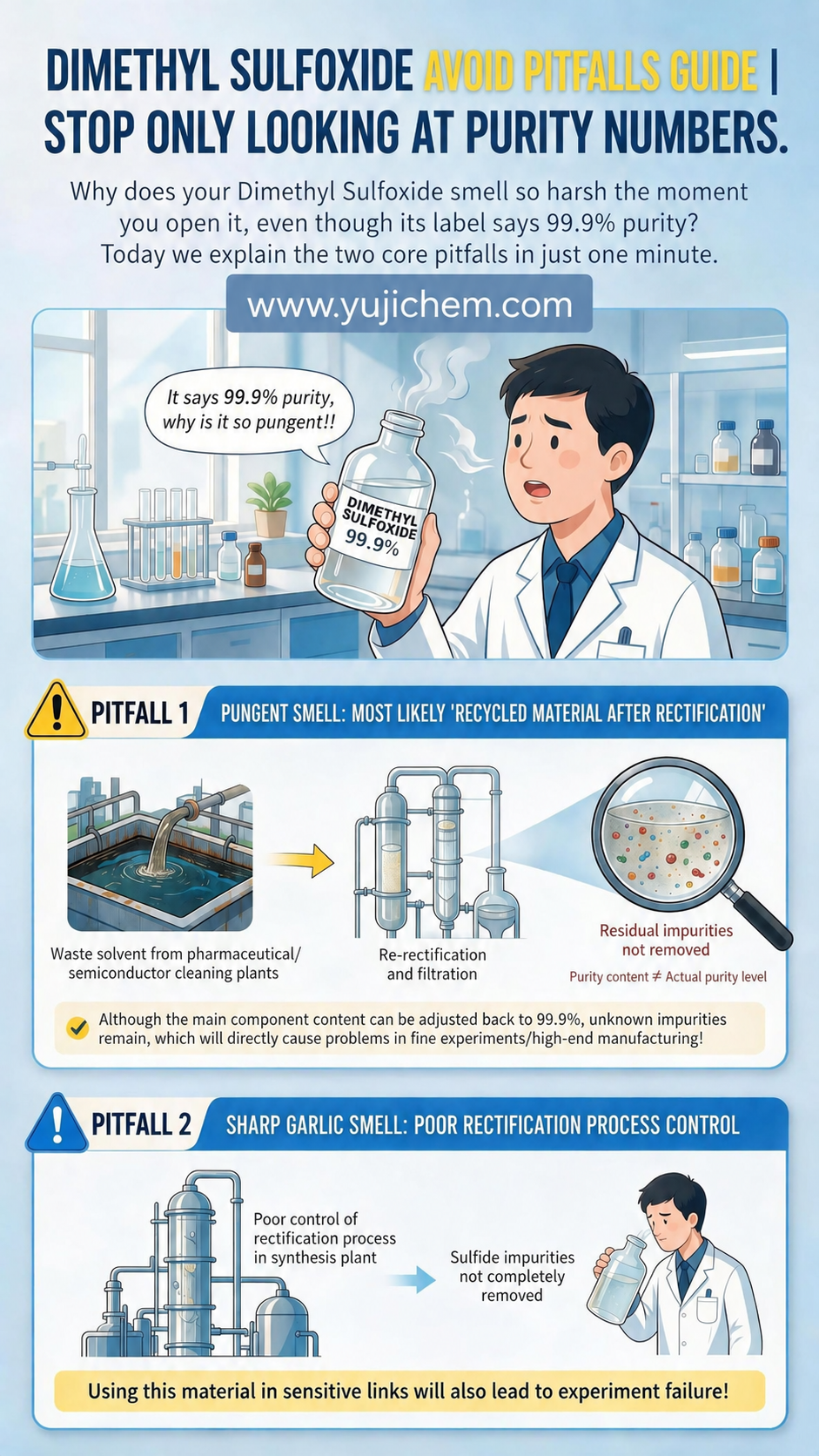
A certificate that reports 99.9% DMSO answers one narrow question: how much of the material is DMSO, measured by chromatography. It does not identify where the material came from, how it was processed, or which trace contaminants remain. Two drums that both assay at 99.9% can differ in odor, color, stability and process behavior. For a buyer, the useful information is often in the items that a single headline percentage was never designed to capture.
- An assay percentage measures DMSO content; it says little about water, individual trace contaminants or the raw-material source.
- Material recovered from spent solvent can reach a high assay again while carrying traces of its original waste stream.
- Odor noticed during normal handling is a screening clue, not a formal test; the source and the full impurity profile should be confirmed on paper.
What an assay percentage actually measures
Purity or assay is typically reported from a chromatogram. It expresses DMSO as a proportion of the peaks detected under that method, and it is good at confirming identity and quantifying other organic compounds that respond to the same analysis. It is not a complete description of the product. Water, specific metals, particles, non-volatile residue and compounds present below the method’s reporting limit are governed by separate tests, each with its own unit and detection limit.
This is why two certificates can show the same 99.9% figure while representing very different material. The percentage is an average over what the method detects; the remaining fraction is not a single known substance, and the tests that were not performed are simply unreported rather than zero.
Virgin versus recovered DMSO
DMSO can be manufactured from virgin raw materials or recovered from spent solvent collected after industrial use. Spent DMSO comes from processes such as pharmaceutical synthesis, semiconductor cleaning and fiber production. After collection it is treated, distilled and filtered, and the main DMSO content can be brought back to a high percentage. Recovery is a legitimate activity and recovered material can be appropriate for less demanding uses, such as certain formulation or cleaning tasks.
The limitation is that a spent stream carries the history of the processes it came from. Repeated distillation removes most contaminants, but trace amounts can remain, and they are not all summarized by the assay figure. In sensitive synthesis, regulated pharmaceutical work or precision electronic processing, those traces can affect an analytical result or a reaction. The decision is not whether recovered DMSO is acceptable in general, but whether it is acceptable for the specific application and supported by the right tests.
Odor as a screening clue
High-quality DMSO is commonly described as having little odor or only a faint characteristic note. Material that gives a sharp, harsh or unusual smell during normal handling may indicate that it was recovered, or that processing did not fully remove volatile contaminants. A distinctly strong garlic-like note can instead point to incomplete removal of sulfide-related impurities during distillation rather than to recycling. Either case deserves follow-up in odor-sensitive or high-precision applications.
Odor is subjective and is not a validated quality method, and it should not replace documented testing. It is best treated as one clue among several: if something about the smell is unusual, confirm the source and the impurity profile rather than relying on the impression.
| Observation during handling | Possible meaning | What to confirm |
|---|---|---|
| Sharp, harsh or hard-to-describe smell | Possibly recovered material with trace volatiles | Virgin or recovered source; impurity profile |
| Strong garlic-like note | Incomplete removal of sulfide-related impurities | Distillation/purification steps; odor on COA |
| Off color or elevated UV absorbance | Residuals such as sulfone or handling history | UV/color data; non-volatile residue |
| High assay but failed customer test | A contaminant the assay method does not cover | Application-specific test methods and limits |
Questions to ask before qualifying
A short set of questions reveals far more than the headline percentage: Is the material virgin or recovered, and what is the raw-material source? Which purification steps are used, and which impurities have documented limits? What test methods back the certificate, and what are their detection limits? Can a representative sample and batch COA be reviewed against the application’s own requirements? Suppliers that can answer these clearly make qualification faster and reduce the risk of a batch failing for a reason the purity number never showed.
For sensitive applications, treat the raw-material source and the recovery status as information you are entitled to, not as a trade secret. The answer, together with the test methods, tells you whether the material is fit for the intended use.
Match the DMSO source to your process
Tell us the application and required limits. We will confirm the source and provide a specification, sample and quotation.
Frequently asked questions
Does 99.9% purity mean the DMSO is virgin material?
No. The assay figure measures DMSO content and cannot distinguish virgin from recovered material. Recovered DMSO can be redistilled to a high percentage, so the source should be confirmed directly.
Can I judge quality by the smell?
Not reliably. Odor is a subjective screening clue and may point to recovery or incomplete purification, but it is not a validated test. Confirm the source and impurity profile on the certificate.
Is recovered DMSO unsafe to use?
Not inherently. Recovered DMSO can suit less demanding applications. For sensitive synthesis, pharmaceutical or electronic work, the trace profile and application-specific tests determine whether it is appropriate.
Why would a high-assay batch fail a customer test?
Because the failing parameter, such as a specific metal, particle or trace compound, is measured by a different method and is not captured by the overall purity percentage.
What should I request before qualifying?
Ask for the source and recovery status, the full specification, the test methods and detection limits, a representative COA and a sample tested against your application’s requirements.