
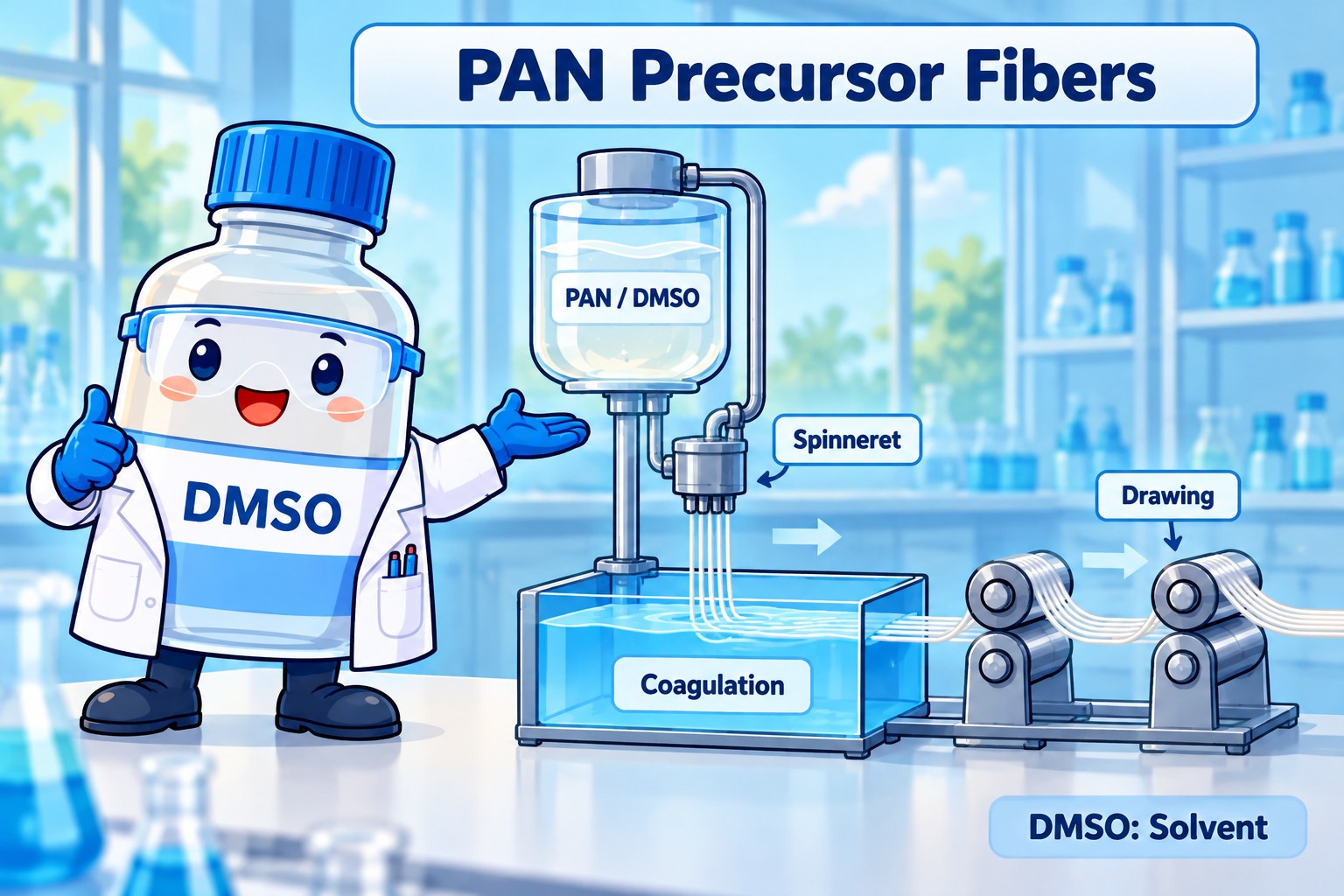
DMSO is used as a solvent in PAN precursor processing for carbon fiber, including the preparation of the spinning solution from which the precursor fiber is wet-spun. Because polyacrylonitrile does not melt without decomposing, it is processed from solution, and the choice and consistency of the solvent directly affect dope quality and spinnability.
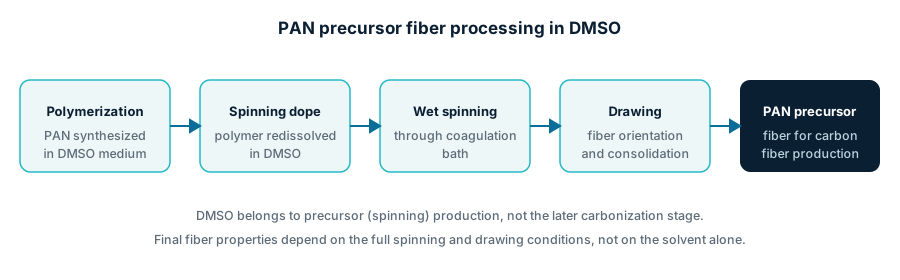
- DMSO serves as the solvent for PAN, both in polymerization and in preparing the spinning dope.
- The dope is wet-spun through a coagulation bath and the fibers are then drawn.
- This is precursor production; DMSO is not used in the later carbonization stage.
Why PAN is processed from solution
PAN and PAN-based copolymers have a high melting tendency coupled with thermal decomposition, so they cannot simply be melt-spun like many thermoplastics. Instead the polymer is dissolved to form a homogeneous spinning dope that can be extruded through a spinneret. DMSO is one of the solvents used to prepare that dope, valued for dissolving PAN and supporting the wet-spinning route.
Polymerization and the spinning dope
The published PAN study describes polymerization carried out using DMSO, followed by polymer processing and redissolution in DMSO to prepare the spinning solution. Using DMSO in both the polymerization medium and the dope simplifies the solvent system; the dope is filtered and deaerated before spinning to remove gels and bubbles that would otherwise cause filament breaks or defects.
Wet spinning and drawing
The dope is extruded through a spinneret into a coagulation bath, where solvent exchange with the bath causes the filaments to solidify. The as-spun fibers are then washed and drawn—often in several stages—to orient the PAN chains, develop tensile properties and consolidate the precursor. Solvent exchange in the coagulation bath and the drawing conditions are central to the structure of the resulting precursor fiber.
Dope quality and the solvent’s effect on spinnability
The spinning dope is a controlled viscoelastic fluid, and its concentration, viscosity and freedom from gels and bubbles largely determine whether it can be extruded continuously. DMSO that varies in water content or carries polymer residues changes dope viscosity and the rate of solvent exchange in the coagulation bath, which can shift filament solidification and drawing behavior. This is why solvent consistency—not just the nominal polymer grade—is treated as a process parameter in precursor manufacturing.
Before extrusion the dope is filtered to remove gels and undissolved material and deaerated to remove bubbles; particles or gels that survive can block spinneret capillaries or create defects and breaks in the running filament. Maintaining clean, dry, consistent DMSO, including DMSO recovered from the bath, therefore supports both spinnability and precursor uniformity, and it reduces downtime from capillary blockage. These controls link directly to the recovery and reuse route described in the companion carbon-fiber article.
Boundary: precursor, not carbonization
DMSO’s role belongs to precursor production—making and spinning the PAN fiber—not to the subsequent stabilization and carbonization stages in which the precursor is converted to carbon fiber under heat in air and then inert atmosphere. Attributing carbonization to DMSO would be incorrect; the solvent is largely removed during coagulation and washing before those later stages.
Tensile strength, modulus and precursor quality depend on polymer composition, dope concentration, coagulation conditions and the full drawing schedule—not on DMSO by itself.
Process considerations
Consistency of the DMSO matters because water content, polymer-related residues and gels affect dope viscosity, filtration and spinnability; solvent that drifts in water content can change coagulation behavior. DMSO is typically recovered from the coagulation bath and wash streams, dehydrated and purified for reuse—a route closely linked to the carbon-fiber solvent recovery article—and the recovered solvent must still meet the quality needed for a clean dope. The grade and COA should be matched to precursor manufacturing.
The as-spun and drawn precursor is later washed to remove the last traces of solvent and salts before drying and winding; incomplete washing can leave residues that affect subsequent thermal stabilization. Coordinating the wash with the recovery loop, which captures the wash solvent, closes both the material balance and the solvent loop. Routine checks of dope viscosity and filtered solids provide an early and clear warning of solvent drift before it reaches the spinneret.
Confirm DMSO for PAN precursor processing
Share your dope and spinning requirements. We will match the solvent grade and provide the batch documentation.
Frequently asked questions
Why can’t PAN be melt-spun?
PAN tends to decompose around its melting behavior, so it is extruded from a solution (spinning dope) instead, commonly prepared in DMSO.
Where does DMSO appear in the process?
In the polymerization medium and in the spinning dope; it is removed during coagulation and washing before the later thermal stages.
Is DMSO used during carbonization?
No. DMSO belongs to precursor production; stabilization and carbonization are later thermal steps performed after the solvent is removed.
Can the DMSO be recovered?
Yes, from coagulation and wash streams, after dehydration and purification; the recovered solvent must still support a clean, spinnable dope.
Why is the dope filtered and deaerated?
Filtration removes gels that could block spinneret capillaries, and deaeration removes bubbles that would cause filament defects or breaks.