
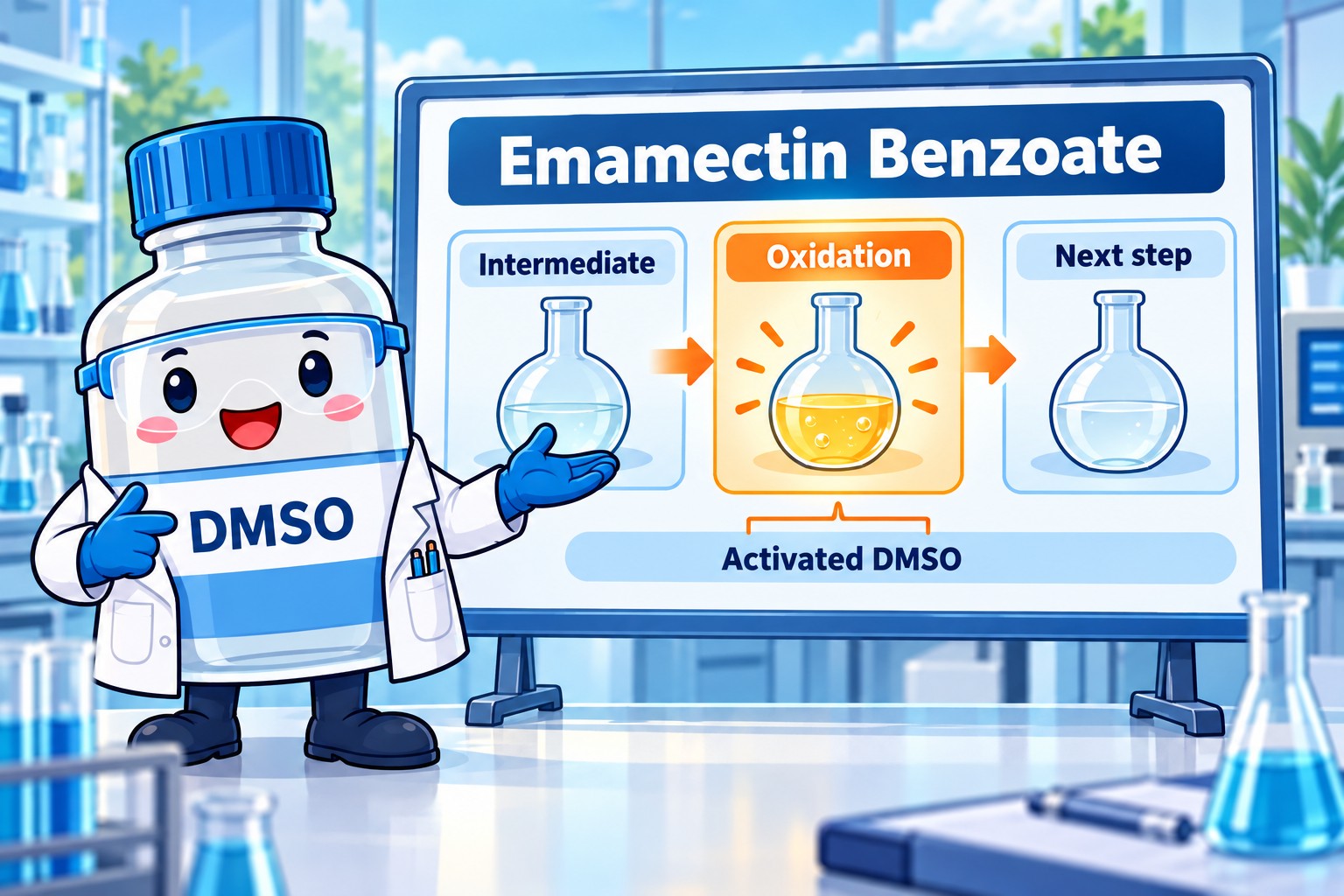
In a published emamectin benzoate synthesis, DMSO is not merely the dissolving medium. It is used as a reagent component of an activated oxidation system: after activation it converts an alcohol group on an intermediate into a carbonyl, ahead of a later amination that introduces the characteristic amine substituent. This places the article in the small but important group of processes in which DMSO chemically participates.
- DMSO is activated by phenyl dichlorophosphate and acts as the oxidant in this step.
- Here DMSO is a reagent, not just a solvent; describing it only as a dissolving medium omits its role.
- Reagent-grade use makes purity, water content and stoichiometry more consequential.
The oxidation step in the emamectin route
Emamectin is produced from an avermectin-type framework through several transformations. The route described in patent CN114181267A includes an oxidation of an intermediate before a subsequent amination. The oxidation system in that step contains DMSO together with phenyl dichlorophosphate, and the resulting carbonyl is then carried forward into later chemistry.
How DMSO is activated
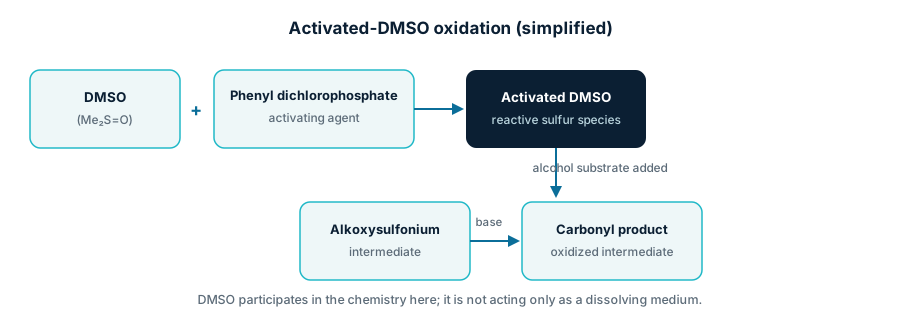
In activated-DMSO oxidations—of which the well-known Swern family is the classic example—DMSO first reacts with an activating agent to form a reactive sulfur species. The alcohol substrate then reacts with that species to give an alkoxysulfonium intermediate, and treatment with a base yields the carbonyl while the sulfur from DMSO is reduced. In the cited emamectin process the activating agent is phenyl dichlorophosphate rather than the oxalyl chloride used in a textbook Swern, but the underlying logic—activate DMSO, react with the alcohol, then eliminate with base—is the same.
Comparing activating agents
DMSO can be activated by more than one reagent. The classic Swern oxidation uses oxalyl chloride, which reacts with DMSO at low temperature and releases carbon monoxide and carbon dioxide; other systems use sulfur trioxide–pyridine, trifluoroacetic anhydride, carbodiimides, or—as in the cited emamectin process—phenyl dichlorophosphate. The choice reflects trade-offs among temperature, by-products, ease of handling and compatibility with a sensitive macrocyclic substrate. Phenyl dichlorophosphate avoids some of the gas evolution and very low temperature associated with oxalyl chloride, which can be attractive at production scale, but it introduces phosphorus-containing by-products that must be removed in the work-up.
Regardless of the activating agent, the chemistry is sensitive to temperature and addition order. Activated DMSO species can decompose or give side reactions if they become too warm or are left standing before the alcohol is introduced, so processes typically control the activation temperature and add the substrate promptly, followed by controlled addition of the base that drives the final elimination.
By-products and work-up
Because DMSO is chemically reduced during the oxidation, sulfur-containing by-products are formed; in classic Swern chemistry these include dimethyl sulfide, which has a strong and readily recognized odor, while a phenyl dichlorophosphate system also yields phosphorus-derived salts and residues. These are separated during quenching, washing and extraction, and the work-up has to be designed to remove both the sulfur and the phosphorus components without losing the carbonyl product. Ventilation, scrubbing and aqueous treatment of the waste streams are normal considerations at scale because of the odor and the reactive nature of the residues.
Solvent versus reagent: the central distinction
Most DMSO applications on this site use the molecule as a polar aprotic reaction solvent or as a stripping medium. In those cases DMSO mainly provides the liquid environment and is recovered largely unchanged. In the emamectin oxidation, by contrast, DMSO is converted during the reaction and supplies the oxygen-transfer chemistry; the amount used is tied to stoichiometry rather than simply to vessel volume. Calling it “a solvent” in this step would be technically incomplete.
Activated sulfur species are moisture-sensitive. Excess water in the DMSO can interfere with activation and reduce effective oxidant, so water content and dry handling deserve particular attention in reagent-grade use.
What this means for purchasing
When DMSO is a reagent, its purity and water content directly affect activation efficiency and the level of side products, and the quantity required scales with the substrate rather than with a fixed solvent charge. Buyers should specify assay and water, confirm them on the batch COA, and allow for the stoichiometric excess typically needed in activated oxidations. The exact equivalents and conditions in the patent are the appropriate source for those values.
Process considerations
Activated-DMSO steps are commonly run with attention to temperature and addition order, because the activated species can be unstable and side reactions can increase if conditions are not controlled. Reaction temperature, the order and rate of addition, and the timing of the base should follow the published procedure and be confirmed during scale-up. As with other DMSO processes, downstream separation and any solvent recovery should be planned in advance, recognizing that the DMSO used in the oxidation is chemically consumed rather than simply recovered. These control measures should be reconfirmed at production scale.
Because the macrocyclic emamectin framework is itself sensitive, development should also confirm that the oxidation conditions do not promote unwanted changes elsewhere in the molecule and that the carbonyl intermediate survives the later amination. Tracking conversion and side products at each addition helps distinguish an activation problem from a work-up loss.
Confirm DMSO for activated oxidation
Share your activation step and grade requirements. We will confirm assay and water content and provide the batch COA.
Frequently asked questions
Is DMSO a solvent or a reagent in emamectin synthesis?
A reagent in the cited oxidation step. After activation by phenyl dichlorophosphate it oxidizes an alcohol to a carbonyl and is chemically converted.
How does activated-DMSO oxidation work?
DMSO reacts with an activating agent to form a reactive sulfur species; the alcohol binds to it, and base treatment gives the carbonyl and reduced sulfur by-products.
Is this the same as Swern oxidation?
The logic is the same, but the cited process uses phenyl dichlorophosphate as the activating agent rather than the oxalyl chloride commonly associated with Swern.
Why is water content especially important?
Activated DMSO species are moisture-sensitive; water can consume the activated oxidant and lower the effective oxidation performance.
How much DMSO is needed?
Because it is a reagent, the amount is stoichiometric and usually includes an excess; refer to the patent’s examples for the specific equivalents.
What by-products does the oxidation produce?
Reduced sulfur species (with characteristic odor in classic systems) plus, with phenyl dichlorophosphate, phosphorus-containing residues that the work-up must remove.