
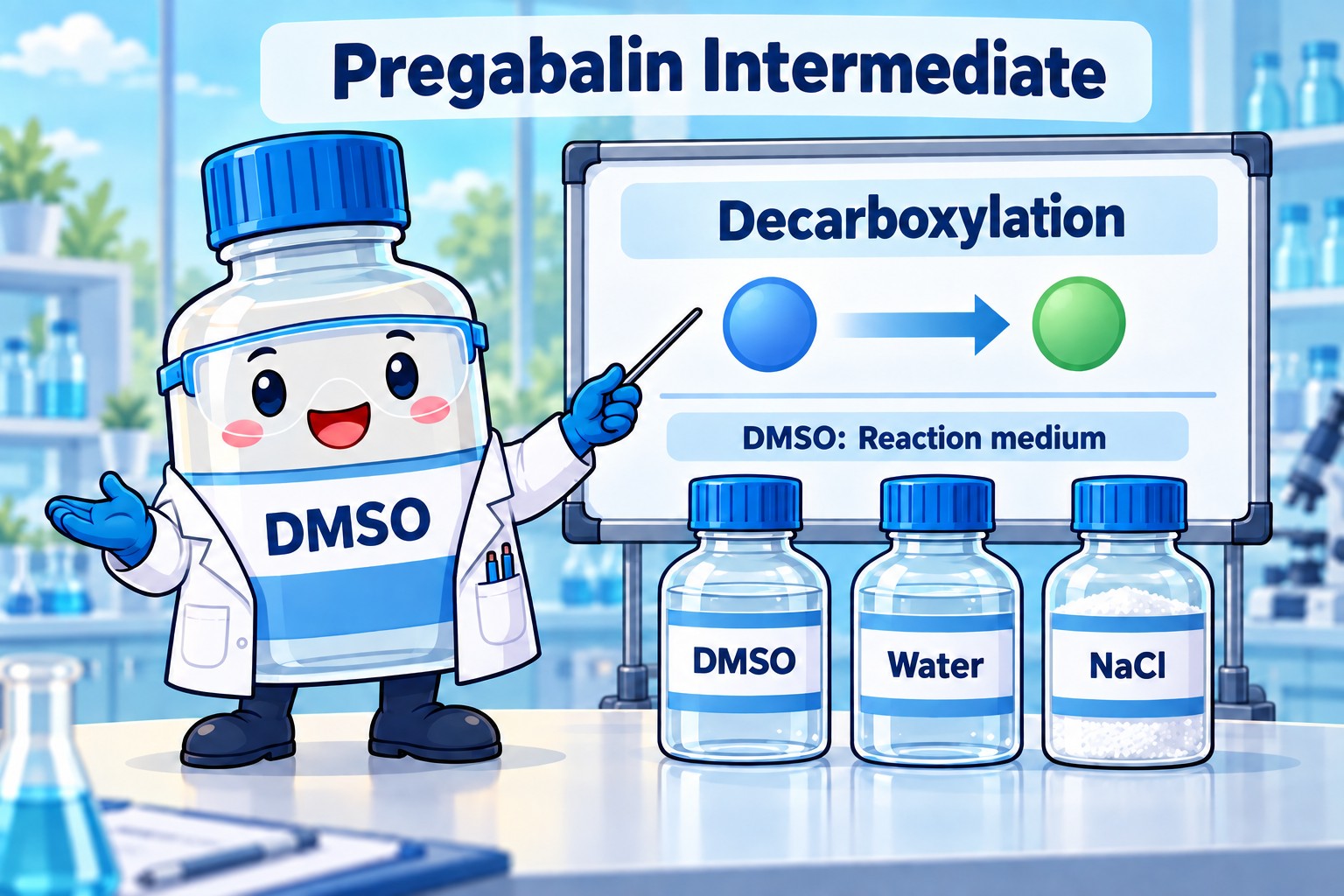
In a published route toward pregabalin, DMSO is used as the reaction medium for a decarboxylation step that produces the cyano ester intermediate ethyl 3-cyano-5-methylhexanoate. The reaction system deliberately includes DMSO together with water and sodium chloride, which makes it a deliberately formulated medium rather than a case of using DMSO alone.
- DMSO is the reaction solvent for the decarboxylation to the cyano ester intermediate.
- Water and sodium chloride are intentionally part of the reaction system.
- DMSO is used in this stage; it is not the source of the cyanide group.
The decarboxylation step
Pregabalin routes build the branched carbon skeleton through intermediates that carry a nitrile and an ester. In the process described by US5637767A, a precursor undergoes decarboxylation to give ethyl 3-cyano-5-methylhexanoate, which is then carried forward into later hydrolysis and resolution steps. The medium for this decarboxylation is a DMSO/water/sodium chloride system.
The DMSO/water/NaCl system
Unlike reactions that use a single anhydrous solvent, this step deliberately combines DMSO with water and salt. DMSO provides the primary organic medium in which the substrate and the decarboxylation chemistry proceed, while water supports the ionic environment and the chemistry of the decarboxylation, and sodium chloride contributes to the salt composition of the medium. Such mixed aqueous/organic systems are chosen when the reaction benefits from a polar, ionic environment that a pure organic solvent does not provide; the exact proportions in the patent are the appropriate reference.
DMSO is the solvent, not the cyanide source
Because the product is a cyano ester, it is worth stating explicitly where the nitrile comes from. The cyanide group is carried by the substrate and retained through the step; DMSO contains no cyanide and does not introduce the nitrile. DMSO’s role is to host the decarboxylation as a reaction solvent, and the molecule is not converted into the cyano group. Confusing these roles would lead to incorrect conclusions about reagent requirements.
This is a Krapcho-type decarbalkoxylation
The DMSO/water/salt combination is characteristic of Krapcho decarbalkoxylation, a method that removes an ester group from a substrate carrying a second electron-withdrawing group—in this case the nitrile. In such a reaction, a chloride salt in wet, hot DMSO promotes cleavage of the ester; the removed group leaves as carbon dioxide and an alkyl chloride, and the substrate is obtained in its decarboxylated form. This accounts for the otherwise unusual presence of both water and sodium chloride in the medium.
DMSO is well matched to this chemistry because it is high-boiling and highly polar, tolerates the temperatures involved, and dissolves both the organic substrate and the ionic salt, while the deliberately added water supports the cleavage step. Here the water and chloride are part of the mechanism rather than contaminants, which is the opposite of a moisture-sensitive activated-DMSO oxidation. The method is valued for being operationally straightforward. The patent’s examples specify the salt, proportions and temperature for the particular cyano ester, and those are the appropriate values to follow.
In contrast to moisture-sensitive activated-DMSO steps, this medium deliberately contains water and salt. The expected water level is part of the recipe, although the DMSO itself should still meet the agreed specification.
Process considerations
The practical challenges include controlling the decarboxylation, handling the aqueous salt medium and separating the cyano ester afterward. The presence of water and sodium chloride affects phase behavior, work-up and any solvent recovery: DMSO is fully miscible with water, so recovering it from a salt-containing aqueous stream requires separation and dehydration rather than simple decanting. Temperature and the composition of the medium should follow the published procedure, and the DMSO grade should be confirmed for assay and water content on the batch COA.
Gas released during the decarboxylation—including carbon dioxide from the removed ester group—should be accounted for in the equipment, and the reaction is typically held until cleavage is complete before the cyano ester is isolated. As elsewhere, the work-up separates the organic product from salts and water, and the DMSO stream is then recovered and dehydrated rather than discarded. Confirming conversion and checking for residual starting ester before work-up avoids carrying unreacted material into the later pregabalin stages. Recovered DMSO quality should be checked before it returns to another batch, since carried-over salts can alter the medium.
Confirm DMSO for your decarboxylation step
Share your reaction outline and grade requirements. We will match the solvent and provide the batch documentation.
Frequently asked questions
Does DMSO provide the cyanide in the intermediate?
No. The nitrile is carried by the substrate; DMSO contains no cyanide and only serves as the reaction medium.
Why are water and salt present?
The decarboxylation is run in a deliberately formulated DMSO/water/sodium chloride medium that provides the polar, ionic environment the step requires.
What is DMSO’s role in this step?
It is the organic reaction solvent for the decarboxylation that yields ethyl 3-cyano-5-methylhexanoate.
How is DMSO recovered from this medium?
Because DMSO is miscible with the aqueous salt phase, recovery needs separation and dehydration rather than simple phase decanting.
What reaction class is this decarboxylation?
It follows the Krapcho decarbalkoxylation pattern: a chloride salt in wet, hot DMSO removes the ester group, with the nitrile retained.