
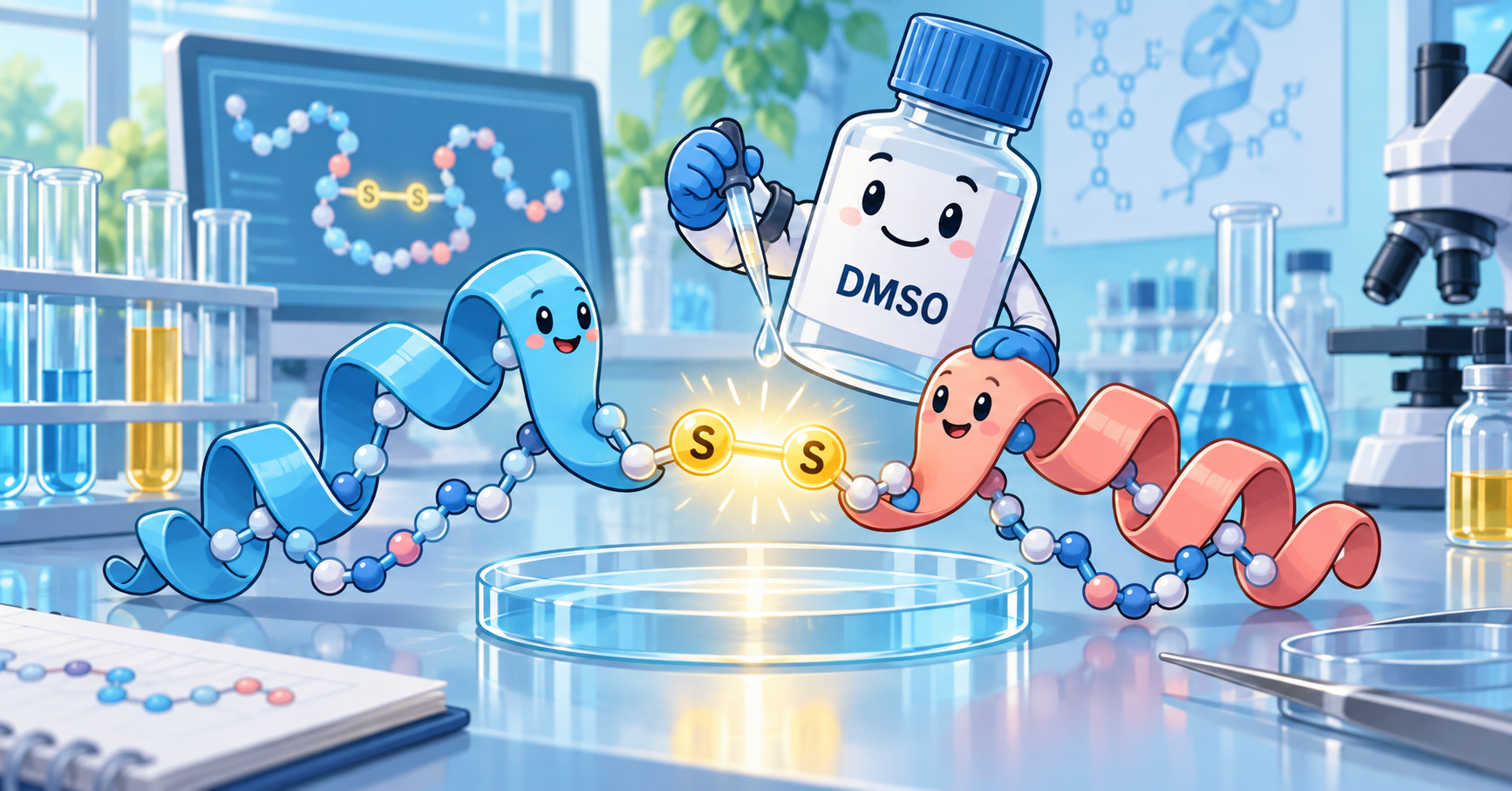
In peptide chemistry DMSO can do more than dissolve difficult material. Under the right conditions it can also participate in oxidation, helping convert cysteine thiols into the disulfide bonds that stabilize a peptide’s structure. This is a case where DMSO changes the redox chemistry of a process, and recognizing that role affects experimental design, impurity investigations and raw-material controls.
- DMSO in aqueous acidic media can oxidize thiols to disulfide bonds, including peptides with more than one bridge.
- The result depends on sequence, protection strategy, concentration, pH, temperature and time.
- A disulfide bond (S-S) is distinct from a thioether linkage; the two should not be confused.
Why disulfide bonds matter
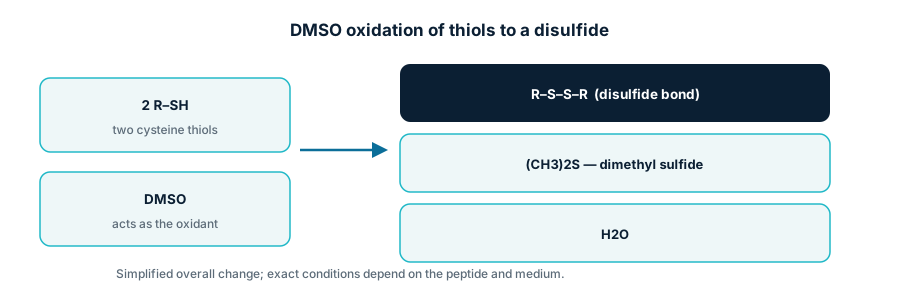
Disulfide bonds help stabilize the three-dimensional structure of many peptides and proteins. Published work, including the DMSO/aqueous acid approach reported by Tam and colleagues, showed that DMSO can oxidize cysteine thiols to form disulfide bridges, and the approach has been applied to biologically relevant peptides and to strategies for forming more than one bridge. DMSO acts as the oxidant and is reduced in the process, commonly to dimethyl sulfide. The simplified stoichiometry is shown below.
Why the route is not a universal recipe
The outcome depends on the peptide sequence, the cysteine protection strategy, concentration, pH, temperature, reaction time and competing oxidation pathways. Peptides that contain more than one disulfide bridge require particular care to form the correct pairings and avoid intermolecular products, and the solvent system must also fit purification and final quality requirements. A condition that works for one sequence can give a different impurity profile for another, so the route should be developed for the specific peptide rather than adopted as a fixed recipe.
| Variable | What it influences | What to monitor |
|---|---|---|
| Sequence & protection | Correct bridge pairing | Regioisomer formation |
| Concentration | Intra- versus intermolecular reaction | Dimer or aggregate content |
| pH, temperature, time | Oxidation rate and side reactions | Conversion and impurities |
| Solvent system | Purification fit | Final quality and residual solvent |
Disulfide versus thioether
The chemistry here should be distinguished from peptide cyclization that closes a ring through a thioether linkage, where sulfur is bonded to carbon on both sides and no oxidation of two thiols occurs. DMSO may support both kinds of process, but the bonds, mechanisms and control strategies differ. Naming the linkage correctly prevents misreading the route and keeps the impurity investigation focused on the right species.
The DMSO/aqueous acid oxidation is associated with Tam and co-workers, and later studies examined DMSO-promoted thiol oxidation. Confirm the conditions against the cited work and develop them for the target peptide.
Specification should follow process function
When DMSO participates in the chemistry, assay, water content and trace impurities should be considered alongside reaction performance, and packaging and storage should protect consistency. Because DMSO is hygroscopic and is acting as an oxidant, moisture and handling can influence the result. A fit-for-purpose specification is built from the needs of the process rather than from a grade name alone.
Match DMSO to your peptide process
Share the sequence, oxidation route, purity and packaging needs, and we will discuss grade and supply.
Frequently asked questions
Does DMSO merely dissolve the peptide here?
No. In this route DMSO acts as an oxidant that converts thiols to disulfide bonds and is reduced, commonly to dimethyl sulfide.
Can DMSO form more than one disulfide bridge?
Yes, published strategies address multiple bridges, but correct pairings require careful control of protection, concentration and conditions.
Is a disulfide the same as a thioether ring closure?
No. A disulfide is an S-S bond formed by oxidizing two thiols, while a thioether has sulfur bonded to carbon; the mechanisms and controls differ.
Why does concentration matter?
Higher concentration can favor intermolecular reaction and aggregates; controlled dilution helps the intramolecular bridge form.
How should the DMSO be specified?
Assay, moisture and trace impurities should match the reaction’s needs, with packaging and storage that protect consistency.