
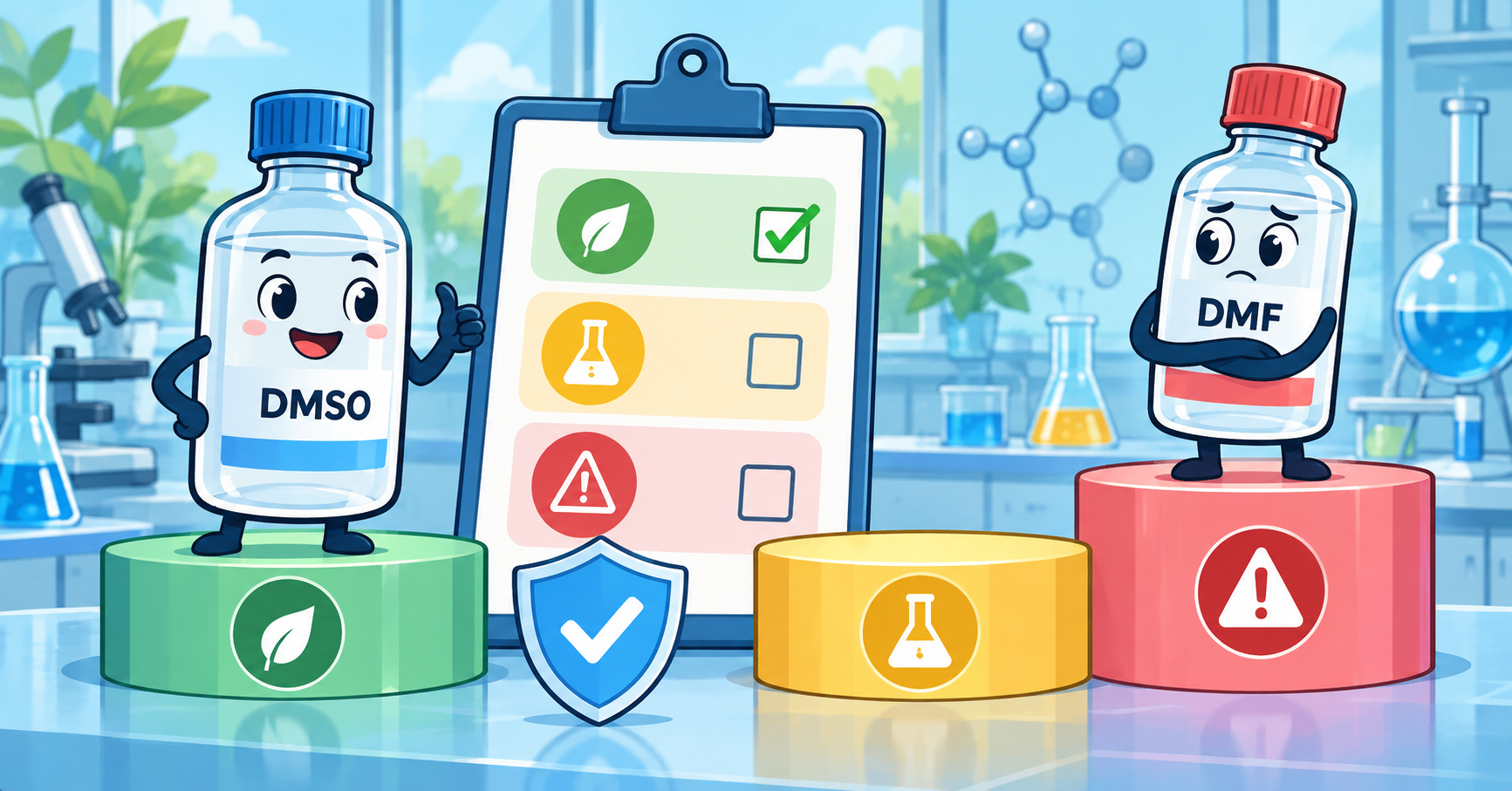
Solvent performance and residual-solvent classification are related but are not the same decision. Two polar, water-miscible solvents can behave similarly in a reactor yet sit in different regulatory classes. DMSO and DMF are a useful example: under ICH Q3C they are not classified together, and the difference changes how residual levels are justified in a pharmaceutical product.
- Under ICH Q3C, DMSO is a Class 3 solvent and DMF is a Class 2 solvent.
- Class 3 describes low toxic potential and supports a general Option 1 limit of 50 mg per day.
- Class 3 is not unlimited; the control strategy still depends on the product and process.
The correct ICH classification
ICH Q3C classifies residual solvents according to risk. DMSO is listed as a Class 3 solvent, described as having low toxic potential, while DMF is listed as Class 2, where tighter limits and more justification apply. The guideline’s general Option 1 approach for Class 3 allows 50 mg per day, which corresponds to 5,000 ppm for a product administered at 10 g per day, without further justification. These figures are the guideline’s general screening values, not a universal specification for every finished product.
| Point | DMSO | DMF |
|---|---|---|
| ICH Q3C class | Class 3 | Class 2 |
| Risk description | Low toxic potential | More limited exposure |
| General Option 1 value | 50 mg/day (5,000 ppm at 10 g/day) | Substance-specific PDE applies |
Class 3 does not mean unlimited
The classification does not make DMSO automatically acceptable or interchangeable with another solvent. The final control strategy still depends on the daily dose and route of administration, the capability of the manufacturing process to purge the solvent, the product specification, applicable pharmacopoeial requirements and customer expectations. A product taken at a different amount, or a process that does not reduce the solvent to the expected level, requires its own justification rather than reliance on the general figure.
Design purge and analysis around the product
For process teams, the practical lesson is to classify the solvent correctly and then design the purge and analytical strategy around the actual product rather than around a slogan. This connects naturally with quality-by-design thinking: reaction performance, impurity formation, isolation and drying capability and analytical control should be assessed as one system. When the expected purge is demonstrated and the residual level is measured, development, quality and procurement share a common basis for the solvent decision.
The classification and the 5,000 ppm figure come from ICH Q3C. Confirm the current revision and apply its limits to the actual dose and product rather than treating the general value as a finished-product specification.
Putting the classification in context
Residual-solvent classification addresses the patient’s exposure to solvent remaining in the medicine; it is separate from workplace safety and environmental rules, which are governed by their own assessments and limits. A favorable ICH class therefore does not remove the need for handling controls, and a solvent’s performance in a reaction does not determine its residual class. Keeping these decisions distinct prevents both overstating and understating what a classification means.
Confirm pharma-grade DMSO for your product
Share the target specification, dose context, package and documentation needs, and we will confirm the matching grade.
Frequently asked questions
Is DMSO a Class 3 solvent under ICH Q3C?
Yes. DMSO is listed as Class 3, described as having low toxic potential, while DMF is Class 2.
What does the 5,000 ppm figure represent?
It is the general Option 1 concentration corresponding to 50 mg per day for a 10 g per day product; it is not a universal finished-product limit.
Does Class 3 mean residual DMSO need not be measured?
No. The process should demonstrate the expected purge and the residual level should still be controlled according to the product and its specification.
Can DMSO replace DMF because it is Class 3?
Not on classification alone. The two solvents differ in performance and properties; any substitution must be validated in the process and product.
Does ICH classification cover worker safety?
No. ICH Q3C addresses residual solvent in the medicine; workplace exposure and environmental rules are assessed separately.