
Lithium-air batteries are widely described as a next-generation technology with a theoretical energy density several times that of conventional lithium-ion, because the cathode uses oxygen drawn from the air rather than storing a heavy intercalation material. In the research behind these cells, DMSO became one of the most studied electrolyte solvents. The same work also exposed how chemically demanding the lithium-air environment is, and DMSO illustrates both the promise and the obstacles of the technology.
- DMSO promotes a solution-growth route in which the discharge product forms micron-sized “donut” particles away from the electrode.
- Its high polarity, dielectric constant around 47, gives it better oxidation stability than many ether solvents.
- Attack by superoxide, reaction with lithium peroxide and corrosion of the lithium anode remain unresolved.
The basic lithium-air concept
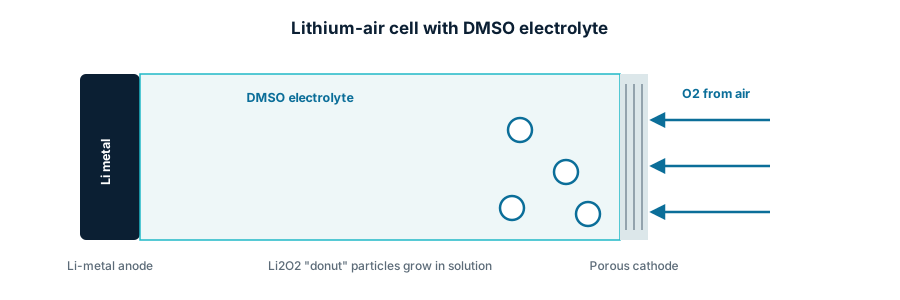
A lithium-air cell pairs a lithium-metal anode with a porous cathode exposed to oxygen, separated by an electrolyte. During discharge, oxygen is reduced and ultimately forms lithium peroxide, and the reverse process should decompose it on charge. Where these reactions occur, at the electrode surface or within the electrolyte, depends strongly on the solvent and determines whether the electrode stays accessible. A simplified concept is shown below.
The “angel” side: two benefits
First, DMSO supports a solution-growth mechanism. In many ordinary solvents the discharge product deposits as a dense film over the cathode and shuts the reaction down early. DMSO dissolves the intermediate species, allowing the product to grow into micron-sized “donut” particles within the electrolyte, which keeps the electrode surface clear and can raise the measured capacity several times. Second, DMSO is comparatively resistant to oxidation, with a dielectric constant around 47, making it more stable than many ether solvents under the high potentials reached on charge.
The “devil” side: three risks
- DMSO is attacked by the superoxide intermediates central to the chemistry and can degrade into by-products.
- On standing, lithium peroxide “donuts” react with DMSO, converting over time toward lithium hydroxide and dimethyl sulfone, so the cell self-discharges and the stored product “rots.”
- DMSO can corrode the lithium-metal anode and promote dendrites that may pierce the separator and cause a short circuit.
| Behavior | Origin | Consequence |
|---|---|---|
| Solution-growth donuts | DMSO dissolves intermediates | Higher usable capacity |
| Superoxide attack | Reactive oxygen species | Solvent degradation |
| Reaction with Li2O2 | Chemical instability on standing | Self-discharge |
| Anode corrosion | DMSO against lithium metal | Dendrites and short risk |
Countermeasures under investigation
Researchers have approached the instability in several ways: protective layers on the lithium anode to limit direct contact, blending DMSO with more stable solvents such as sulfolane, and efficient catalysts to lower the overpotential and reduce the time the reactive products persist. These measures can improve individual results, but a solvent that supports high capacity yet degrades on standing and attacks the anode is not yet a practical electrolyte. Much of DMSO’s value has been in helping map the reaction mechanisms that any successful lithium-air electrolyte must manage.
Lithium-air chemistry and DMSO’s role in it remain laboratory subjects. The figures describe observed research behavior and should not be read as evidence of a commercial battery or a qualified production application.
Support for energy-storage research
Tell us the grade, moisture and documentation needs, and we can support laboratory and development volumes.
Frequently asked questions
Why did researchers choose DMSO for lithium-air cells?
Because it dissolves the oxygen-reduction intermediates, allowing lithium peroxide to grow as particles in solution rather than blocking the cathode, and it has comparatively good oxidation stability.
What are the “donut” particles?
They are micron-sized, ring-like lithium peroxide particles that grow in the electrolyte under a solution-growth route, leaving the electrode more accessible.
Why is DMSO not yet a practical electrolyte?
It is attacked by superoxide, reacts with lithium peroxide on standing to form hydroxide and sulfone, and can corrode the lithium anode and promote dendrites.
How are these problems being addressed?
Approaches include protective anode layers, blending with stable solvents such as sulfolane, and catalysts that reduce overpotential.
Is lithium-air a commercial technology today?
It remains largely a research technology. DMSO’s role has been important for understanding the mechanisms rather than indicating a qualified production use.