
The quality ceiling of DMSO is partly set before the oxidation step, at the raw-material stage. A common manufacturing route reacts hydrogen sulfide with methanol to form dimethyl sulfide, which is then oxidized to DMSO. The hydrogen sulfide itself comes mainly from two sources: desulfurization tail gas from refineries or fertilizer plants, and byproduct gas from carbon-disulfide production. Both are chemically H2S, but they differ in purity, cost and supply stability, and those differences carry through to the finished solvent.
- DMSO is commonly made via H2S plus methanol to dimethyl sulfide, followed by oxidation.
- CS2 byproduct gas is purer and simpler; refinery tail gas is cheaper but needs more purification.
- For high-end grades the cleaner source reduces risk; for cost-driven grades the tail-gas route can work with proper engineering.
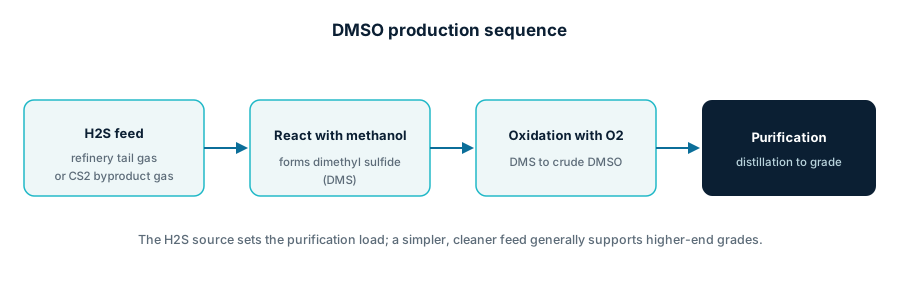
The DMSO production sequence
In the established route, hydrogen sulfide and methanol are reacted to produce dimethyl sulfide, with the reaction and byproducts controlled by the catalyst and operating conditions. The dimethyl sulfide is then oxidized, commonly with oxygen or air under controlled conditions, to DMSO, which is subsequently purified by distillation. The simplified sequence is shown below.
Comparing the two H2S sources
The source gas determines how much purification is needed before it can be used. Refinery desulfurization tail gas is a mixture that can contain carbon dioxide, hydrogen, methane and traces of carbon monoxide or hydrogen cyanide, so it requires decarbonization and hydrocarbon-removal units. Byproduct gas from CS2 production has a simpler composition, contains almost no carbon monoxide or cyanides, and can reach high purity, commonly above 98%, with relatively simple condensation and adsorption.
| Dimension | Refinery / fertilizer tail gas | CS2 byproduct gas |
|---|---|---|
| Purity | Mixed with CO2, H2, methane and trace CO/HCN; needs removal units | Simple composition; high purity via condensation and adsorption |
| Cost | Cheap environmental byproduct, but high purification investment | Better quality, but requires integrated industry chains |
| Supply stability | Large and stable, but crude-type changes alter gas volume | More cyclical; supply may be cut in market downturns |
Purity and its effect on the finished grade
Trace components in the source gas do not all disappear in later steps without effort. A simpler, cleaner H2S source reduces the load on downstream purification and lowers the risk that volatile or nitrogen-containing traces survive into the final product. This is particularly relevant for electronic and pharmaceutical grades, where the impurity profile is tightly specified and documented. A mixed source can still produce high-quality DMSO, but it depends on correctly engineered gas treatment, and the buyer should be satisfied that those steps are in place.
Cost and supply tradeoffs
Refinery tail gas is inexpensive because it is an environmental byproduct that would otherwise be treated as waste, but the gas-cleaning equipment represents a fixed investment. The CS2 route offers cleaner feed gas but relies on integration with carbon-disulfide production, which is more exposed to industry cycles and can reduce output during downturns. Security of supply therefore has to be weighed alongside feed-gas purity, especially for buyers who depend on consistent deliveries.
For high-end electronic and pharmaceutical grades, the cleaner CS2 byproduct source reduces purification risk. For cost-driven industrial and agrochemical grades, properly purified refinery tail gas is a defensible, lower-cost option.
Ask how your DMSO is produced
We can explain the source and route and provide the specification that matches your grade.
Frequently asked questions
Is DMSO made directly from hydrogen sulfide?
In a common route, H2S is first reacted with methanol to form dimethyl sulfide, which is then oxidized to DMSO and purified.
Which H2S source gives the cleanest DMSO?
CS2 byproduct gas has a simpler, purer composition and generally reduces the downstream purification load, which suits high-end grades.
Can refinery tail gas make pharmaceutical-grade DMSO?
Yes, provided the gas is correctly treated to remove carbon dioxide, hydrocarbons and trace contaminants, and the final product meets the agreed specification.
Why does the source affect price?
A mixed, low-cost source requires more purification equipment, while a cleaner source often relies on integrated production; both structures affect cost and availability.
Which source offers more stable supply?
Refineries are large but tail-gas volume changes with crude type; CS2 output is more cyclical. Security of supply should be assessed alongside purity.